The Minister of Local Government, Chieftaincy and Religious Affairs, Ahmed Ibrahim, has reaffirmed government’s commitment to deepening transparency, accountability and inclusive development across Ghana’s local governance system.
Delivering an address as the Chairman of the Decentralisation Sector Working Group (DSWG) at the DSWG meeting held in Accra on Monday March 2, 2026, the minister outlined key achievements in 2025 and announced major priorities for the 2026 fiscal year.
He highlighted the successful launch of the National Sanitation Day (NSD), dubbed the “Clean Up Ghana” initiative, which was inaugurated on September 6, 2025, by President John Dramani Mahama at the Institute of Local Government Studies in Accra.
Observed on the first Saturday of every month, the initiative aims to tackle sanitation challenges in cities and towns, improve public health outcomes and boost tourism.
On administrative reforms, Ibrahim disclosed that a committee chaired by Johnson Asiedu Nketiah has submitted its report on the proposed upgrade of selected districts and municipalities.
The report recommends upgrading 12 municipalities and one district, as well as elevating 20 districts to municipal status. The minister said he is reviewing the document before forwarding it to the President for Executive approval to pave the way for the issuance of Legislative Instruments.
Sanitation to determine MMDCEs' performance – Local Government Minister
He stressed that the reclassification process is being guided by objective standards, including population growth, infrastructure readiness and service delivery capacity.
In line with the government’s “Funds Follow Functions” agenda, the Ministry of Finance, through the Office of the District Assemblies Common Fund (DACF), released GH¢6.29 billion covering all four quarters of the 2025 fiscal year to Metropolitan, Municipal and District Assemblies (MMDAs).
Out of this amount, GH¢4.3 billion has already been disbursed, with the fourth quarter currently being processed.
Additionally, GH¢810 million under the DACF–Responsiveness Factor Grant (RFG) Programme is expected to be transferred to MMDAs in the second quarter of 2026 following the completion of the 9th cycle of the District Assemblies Performance Assessment Tool (DPAT).
In what he described as a historic first, the Minister announced that government has disbursed GH¢100 million as monthly allowances to Assembly Members nationwide.
He said the intervention is aimed at empowering Assembly Members to effectively carry out their responsibilities at the grassroots level.
“The Ministry has also increased monthly allowances for Paramount Chiefs from GH¢1,200 to GH¢3,000 and for Queen Mothers from GH¢800 to GH¢2,400 representing a 300 percent increment.”
According to Ibrahim, the move is expected to strengthen the chieftaincy institution and enhance its contribution to national development.
As part of the government’s economic transformation drive, the Ministry is collaborating with the 24-Hour Economy Secretariat to construct modern 24-hour markets in all 261 MMDAs.
Ibrahim disclosed that designs for the markets have been finalised and procurement processes are far advanced to commence construction nationwide.
He noted that the initiative will stimulate local economic activity, improve trading conditions and create jobs.
The minister announced that the National Decentralisation Policy and Strategic Framework (NDPSF 2026–2030), finalised in collaboration with the Inter-Ministerial Coordinating Committee on Decentralisation (IMCCoD), is ready for submission to Cabinet.
Similarly, the revised National Urban Policy (2026–2036) and its Implementation Plan have been completed and are awaiting Cabinet approval.
“These milestones reflect steady progress in implementing our decentralisation priorities,” he said.
He announced that President John Dramani Mahama will commence a Regional Accountability Series in the Bono Region on March 18, 2026, aimed at deepening social accountability, reducing audit infractions and enforcing zero tolerance for corruption.
“There is no gain stating the joy on pupils, market women, health workers and traditional leaders as a result of these interventions,” the minister noted.
Meanwhile, watch GhanaWeb’s exposé on the 'dark side of Kayamata' and its devastating impact
Business News of Monday, 2 March 2026
Source: www.ghanaweb.com
We are resetting local governance for inclusive development – Ahmed Ibrahim
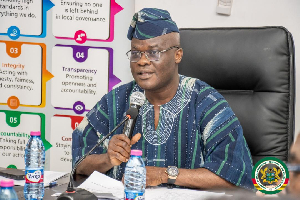 Minister of Local Government, Chieftaincy and Religious Affairs, Ahmed Ibrahim