Ghana’s Minister of State for Climate Change and Sustainability, Seidu Issifu, has issued a bold call for Climate Debt Forgiveness for countries in the Global South, arguing that the growing debt burdens of African nations are a direct consequence of a climate crisis they did not create.
Speaking at the Second High-Level Informal Roundtable hosted by the Africa-Europe Foundation (AEF), the African Union Commission (AUC), and the Pan-African Climate Justice Alliance (PACJA) on the sidelines of the UNFCCC SB62 in Bonn, Hon. Issifu called on European policymakers and global climate leaders to rethink the approach to climate finance.
“The Global South is drowning in debt because we have been forced to borrow our way out of a crisis we did not cause,” he said.
“Every loan we take to rebuild after floods, to adapt our farms, or to treat climate-induced diseases is climate debt — and that debt must be forgiven.”
Issifu urged world leaders to move the conversation beyond climate aid and concessional loans to a model of climate justice and reparations.
He emphasised that, Africa contributes less than 4% of global emissions but bears the brunt of climate disasters.
Debt accrued by African nations is often used for adaptation and resilience measures.
Ongoing debt servicing limits domestic investment in critical sectors like public health, climate-smart agriculture, and animal disease control.
“Debt forgiveness must be a fundamental part of any serious climate finance package heading into COP30,” he stated.
“Ambitious climate targets without climate justice are hypocrisy.”
Issifu also highlighted the strain climate change places on animal health systems, food security, and rural livelihoods, pointing out that funds used to repay debt should instead be invested in veterinarians, farmers, and researchers tracking climate-driven zoonotic diseases.
“We need a climate finance framework that understands debt forgiveness as a precondition for resilience,” he stressed.
Looking ahead to COP30 and the 7th AU-EU Summit, Issifu proposed, An Africa-Europe Compact on Climate Debt Justice.
Debt relief as a core climate finance instrument in the Baku to Belem Roadmap.
Targeted investments in climate-resilient infrastructure, animal health, and early-warning systems.
A global framework for loss and damage compensation that includes automatic debt cancellation after climate disasters.
As the world prepares to mark the 10th anniversary of the Paris Agreement in 2025, Issifu called for moral leadership and real action.
“Debt cancellation is not just a fiscal policy; it is a lifeline. It is a statement that the world sees us, hears us, and is ready to walk with us,” he concluded.
His message resonated strongly with several European stakeholders, as the forum grappled with how to rebuild trust and foster genuine climate solidarity in an era of tightening development budgets and increasing global crises.
How social engineering hacks your mind and your bank account
Business News of Thursday, 26 June 2025
Source: Cedric Dzelu, Contributor
Seidu Issifu calls for climate debt forgiveness for Global South at Africa-Europe Dialogue
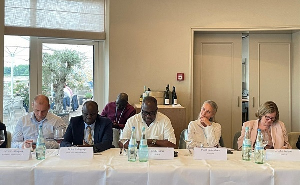 Issifu Seidu, Minister of State in charge of Climate Change and Sustainability at the dialogue