The government’s repeal of the Electronic Transaction Levy (E-Levy) on Wednesday April 2, 2025 has fulfilled one of the key demands expressed by Ghanaians ahead of the 2024 elections.
In a survey conducted by Afrobarometer in August 2024, around four out of five citizens voiced their opposition to the levy, which was introduced in May 2022.
The survey revealed strong public dissatisfaction, with many considering the E-Levy an undue tax burden.
Both major political parties had called for its repeal during their election campaigns, further emphasising the desire for change.
Since its implementation, the E-Levy faced widespread criticism, with Ghanaians questioning the government's ability to effectively utilize the generated revenue for development projects.
The repeal, which was signed into law by President John Dramani Mahama on April 2, 2024, also includes the removal of the emissions tax and a betting tax, marking a significant shift in the government's approach ahead of the 2025 budget.
According to survey findings, Ghanaians continue to support several other government initiatives.
The free senior high school program remains highly popular, with 85% of respondents backing its continuation.
Other initiatives such as the Planting for Food and Jobs program (81%), One District, One Factory (71%), and One Village, One Dam (60%) also enjoy significant support.
The repeal of the E-Levy signals the government's responsiveness to public concerns, ahead of a critical election year.
With the removal of this contentious tax, the focus now shifts to how the government will address other pressing issues and maintain support for its remaining initiatives.
Key findings from the survey include:
• 79% of Ghanaians favored discontinuing the e-levy, with strong opposition across various demographic groups, including 83% of men, 83% of youth, 86% of the poorest citizens, and 87% of those with post-secondary education.
• In a 2022 survey, 76% of respondents labeled the e-levy as a bad idea, citing its potential to increase the tax burden on ordinary citizens, especially the poor. Nearly two-thirds (63%) strongly agreed with this sentiment.
• A large portion of respondents (75%) expressed a lack of confidence that the government would effectively utilize the revenues generated by the e-levy to fund development programs. Specifically, 24% were “not very confident,” and 51% were “not at all confident.”
See the full report below:
MA
Business News of Thursday, 3 April 2025
Source: www.ghanaweb.com
Repeal of E-Levy aligns with Ghanaians' wishes ahead of 2024 election - Survey
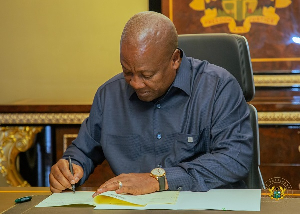 President John Dramani Mahama after assenting to the bills