The Rainforest Alliance Ghana has convened a high-level partners and stakeholders workshop in Accra, rallying sustainability managers, policymakers, private sector actors, and farmer representatives to chart a path toward more sustainable agricultural value chains and regenerative landscapes.
The workshop, held at the AH Hotel, Accra, introduced stakeholders to the Rainforest Alliance 2030 Strategy, the Sustainable Agriculture Standard Version 1.4, and its policy for West and Central Africa.
Participants included representatives from COCOBOD, the Forestry Commission, UNDP, private sector actors, farmer groups, and traditional authorities.
Founded in 1987, the Rainforest Alliance has been at the forefront of fostering biodiversity, enhancing climate resilience, and improving rural livelihoods.
In 2024 alone, its programmes reached more than 25 million hectares globally, with certified crops produced according to rigorous environmental, social, and economic sustainability standards.
Today, the organisation works in 62 countries, promoting sustainable land management and helping rural economies thrive, a proven strategy to safeguard tropical forests and restore biodiversity.
Opening the workshop, Rainforest Alliance Ghana Country Director Nicholas Jengre emphasised the importance of building stronger partnerships to deliver the organisation’s 2030 Strategy in Ghana. “Our vision is a world where people and nature thrive in harmony,” he said.
“Achieving this requires us to align our efforts, share lessons, and pool resources to drive transformational change across entire landscapes.”
Echoing this call, Nadège Nzoyem, Senior Director for West & Central Africa, urged greater regional collaboration to tackle shared sustainability challenges. “Sustainability is no longer an optional commitment, it is the foundation for future competitiveness, climate resilience, and inclusive growth,” she noted.
“The lessons and innovations emerging from Ghana’s cocoa and forest landscapes can serve as powerful models for the entire region.”
The programme featured sessions on Rainforest Alliance’s certification data in Ghana, an overview of the Sustainable Agriculture Standard Version 1.4, and spotlights on key landscape initiatives, including the Sui River and Savannah landscapes.
Discussions highlighted how integrated approaches to forest conservation, community engagement, and market linkages can drive net-positive outcomes for people and nature.
A panel session titled “Transformational Change for Net Positive Landscapes in Ghana” brought together representatives from the Forestry Commission, COCOBOD, UNDP, private sector, Rainforest Alliance, and farmer groups.
Speakers underscored the need for policy alignment, investment in regenerative practices, and capacity-building at the community level.
The workshop concluded with a renewed pledge from all stakeholders to deepen collaboration, scale solutions, and maintain open channels of communication.
Closing the event, Nana Kwabena Gyanfi Akwabeng, Abontendom Hene of Anhwiaso Traditional Authority called on participants to translate their commitments into tangible benefits for farmers and forest-dependent communities.
With nearly four decades of global impact and a strong track record in Ghana, the Rainforest Alliance is positioning itself, alongside its partners, to ensure that cocoa, forests, and landscapes can thrive together for generations to come.
Business News of Saturday, 16 August 2025
Source: Geroge Owusu, Contributor
Rainforest Alliance hosts partners’ workshop to advance Cocoa, forest and landscape sustainability
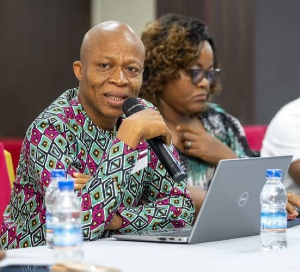 The programme featured sessions on Rainforest Alliance’s certification data in Ghana