The DIHOC Footwear Division Limited, known as the Kumasi Shoe Factory, is installing new machinery capable of producing up to 15 million pairs of school sandals annually, but says the expansion will not translate into jobs without firm government policy enforcement.
The company is calling on government, through the Minister of Education, Haruna Iddrisu; Minister of Interior, Muntaka Mohammed Mubarak; and acting Minister of Defence, Dr Cassiel Ato Forson to direct public schools and security agencies to wear locally made footwear, arguing that without a guaranteed market, the 24-hour economy agenda will remain unfulfilled.
The Board Chair of the company, Dr Karl Laryea, said the factory could employ about 1,500 additional workers if sustained demand for locally produced shoes is created through enforceable directives.
He said similar policies were already being enforced in countries such as South Africa and India, where public institutions are required to buy locally manufactured goods as a way of building domestic industries.
“This is how those countries built their local industries,” he said. “They directed public institutions to buy local, created competition among manufacturers, and jobs followed.”
Dr Laryea said the planned expansion could lead to the employment of about 1,500 additional workers, but only if a firm policy directive creates a dependable local market.
According to him, the factory is installing new assembly lines in March next month that would significantly scale up production, including school sandals for basic schools and boots for security agencies.
He said the factory is capable of producing between 10 million and 15 million pairs of school sandals annually, as well as more than 700,000 pairs of assorted security boots and shoes each year. Despite this capacity, the factory currently operates at only about eight percent of its installed capacity.
Dr Laryea said a directive requiring public schools to wear locally made footwear would not only stimulate the shoe industry but also help government sustain the 24-hour economy by ensuring steady demand.
He added that locally produced school sandals could be supplied at a lower cost, noting that duty exemptions already exist for some raw materials used in production.
He warned that continued importation of footwear by public institutions puts unnecessary pressure on the cedi and weakens local manufacturing capacities.
Dr Laryea also criticised the persistent refusal of state institutions to comply with government directives on local procurement.
In 2014, then President John Mahama, directed state agencies to procure their footwear from the Kumasi Shoe Factory, but none complied.
A similar directive issued last year by the Minister for the Interior, Muntaka Mohammed Mubarak to all the agencies under the ministry, has also not been enforced.
The agencies involved include the Ghana Police Service, Ghana National Fire Service, Ghana Prisons Service, Ghana Immigration Service, the National Disaster Management Organisation, and the National Service Secretariat.
“I have personally gone to engage these agencies. We have written twice. Still, nobody is buying,” Dr Laryea said.
He said the agencies have refused to provide us with their size specifications, known as size rolls, which are requirement for production.
Instead, some have asked the factory to produce footwear without confirmed sizing and promised to purchase later.
According to him, this approach makes proper planning impossible and opens the door for continued importation.
Dr Laryea said enforcement must go beyond issuing directives. “If you are the head of a department and you refuse to comply with a government directive, there must be consequences,” he said.
He also drew attention to the social cost of the current situation, noting that while schools and security services import footwear, some deprived districts still have children attending school barefooted.
Understanding Ghana's stock market and how to invest | BizTech
Business News of Tuesday, 10 February 2026
Source: thebftonline.com
Kumasi Shoe Factory pushes for compulsory school footwear directive
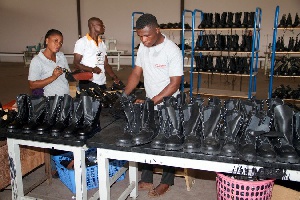 File photo of a shoe factory