India seeks to build a formidable ‘brain bridge’ with Ghana through research and academic collaborations to solve shared economic challenges.
Following the elevation of the bilateral relations between the two countries to a comprehensive partnership, India sent visiting professors to the University of Cape Coast to understudy Ghana’s curricula and identify opportunities for collaborative research.
The Indian High Commission in Ghana then convened a roundtable meeting with academics from various universities and civil society to discuss areas of possible collaboration. The most urgent area of focus identified is informal work that dominates both economies.
The academics proposed a first-of-its-kind research collaboration aimed at solving common developmental challenges, from the vast informal economy to youth unemployment. Areas of collaboration include joint research projects, faculty exchanges and co-publications.
Speaking at the meeting, the Chairperson of the Centre for Informal Sector and Labour Studies at Jawaharlal Nehru University (JNU), Prof Minaketan Behera, an architect of the effort, who is in Ghana on a three-month research exchange, stated that the dialogue was the crucial “starting point” to move from ideas to action.
“We have discussed many dimensions: joint research on the informal economy, agriculture and traditional medicine. The next step is to identify one core area, find the funding mechanism and begin producing collaborative work that benefits both nations,” Prof Behera said.
The labour studies expert cited his engagements with ride-hailing platforms like Yango, Bolt and Uber and ‘gig’ workers in Ghana to buttress his conviction that Ghana is no different in the global south development challenges.
“I find there is no difference between the informal sector in India and in Ghana. The problems they tell me—working 12 hours a day for low pay, high commissions—are the same. We need collaborative research to advise our governments on social security, income stability and job security for these workers,” he added.
As the two governments work to double bilateral trade, Prof Behera indicated that the research agenda will aim at addressing the “demographic dividend,” the large youth populations in both India and Ghana.
“The focus will be on developing academic programmes that foster practical skills, data analysis and entrepreneurship to create employment beyond the pursuit of public sector jobs,” he emphasised.
The Indian High Commissioner to Ghana, Manish Gupta, underscored the ambitious goal of doubling bilateral trade to US$6billion, identifying “capacity building” as the cornerstone for a thriving partnership.
He stated that the people-to-people and academic linkages provide “stability” for the relationship, upon which deeper economic ties can be built.
He stressed that “new ideas and fresh efforts” from experts were essential to deepen the partnership. The research collaboration is expected to support government-to-government initiatives, including those announced during PM Narendra Modi’s visit, notably the plan to establish Ghana as a vaccine production hub for West Africa and partnerships in Fintech and solar energy.
In line with this, Gupta revealed that Ghana is set to host the first regional meeting of the International Solar Alliance (ISA), signalling a major step in deepening the clean energy partnership between the two.
Gupta positioned the ISA meeting as a prime example of the two nations’ shared commitment to “reformed multilateralism” and appetite for solving contemporary global challenges.
“The issues that we deal with are so vast and so interlinked. We need global solutions. In India, our focus is to look into issues that are contemporary. The International Solar Alliance is one of the new structures through which we are able to accommodate the challenges that are facing us all.”
The ISA, co-founded by India and France, aims to harness solar energy to reduce dependence on fossil fuels, focusing on solar energy adoption, technology transfer and building climate-resilient infrastructure.
However, Ghana’s role as ISA’s first host in the region positions it as a potential leader for solar power in West Africa.
In view of these developments, Prof Behera outlined concrete steps to institutionalise the academic link and unlock funding for research. These include a proposal to have Ghana included in the funding platform of the Indian Council of Social Science Research (ICSSR), which currently supports joint projects with countries like Japan and the UK, and expansion of the Indian Council for Cultural Relations (ICCR) scholarships scheme to many Ghanaians.
“This is not a one-way street. We are here learning your culture, moving through universities and villages. The goal is a true two-way exchange of knowledge,” Prof. Behera emphasised.
Business News of Wednesday, 3 September 2025
Source: thebftonline.com
India forges 'brain bridge' to tackle shared economic challenges
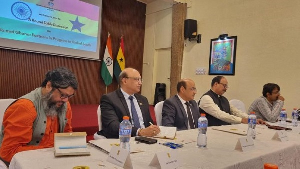 The Commission convened a roundtable meeting with academics from various universities




Entertainment