The government has been urged to introduce and implement deliberate policies that will encourage more women to invest and venture into the aquaculture sector.
When women increase investment in the fish farming sector, it will not only increase yield in local fish production but will also promote economic empowerment and improve livelihoods for women.
Mabel Ibidun Quarshie, the Founder of Aquatic Foods Limited (AFL), speaking to Ghana News Agency (GNA) in an interview in Kumasi, said stakeholders in the industry had always intensified calls for support for women to increase their participation in the sector as part of efforts to promote economic empowerment and improve livelihoods for women across the country.
She said women continued to play a critical role in the aquaculture value chain, contributing to fish production, processing, marketing, and distribution, particularly in inland cities such as Kumasi.
She noted that the Minister of Fisheries and Aquaculture, Emelia Arthur, had underscored the importance of women’s participation, noting that their involvement was key to achieving sustainable growth in the sector.
Ben Nunoo Mensah: The Ghanaian business tycoon behind the Barari DV lithium concession
Quarshie said the government must keep its word and be committed to implementing policies and programmes aimed at enhancing women’s access to resources, training, and financing opportunities.
She noted that in the Ashanti Region, women were increasingly venturing into fish farming and related businesses, moving beyond traditional roles of fish processing and trading, into production and enterprise development.
This shift, she added, had been supported by capacity-building initiatives, provision of fingerlings and feed, and access to modern aquaculture technologies introduced by government agencies and development partners.
She stressed the need for more stakeholders to get on board in advocating inclusive growth, highlighting the need to create enabling conditions for women entrepreneurs in the sector.
She said she had been recognised for promoting innovation and supporting women to scale up their aquaculture businesses.
Quarshie said she had also been instrumental in organising training programmes and resilience-building initiatives for women affected by economic and environmental challenges.
She stressed that, despite their contributions, women in aquaculture continued to face significant barriers, including limited access to land, credit facilities, and modern equipment.
She pointed out that, cultural and infrastructural constraints had restricted womens participation in decision-making processes within the fisheries and aquaculture sectors.
To address these challenges, she said targeted interventions such as microfinance schemes, cooperative development, and skills training programmes must be implemented to empower women economically.
She also called for increased initiatives such as improved fish smoking technologies and climate-smart aquaculture practices that could help women increase productivity, while reducing health risks and environmental impact.
This, she said, would result in improved incomes, enhanced food security, and greater financial independence, enabling them to support their families and invest in their children’s education.
She emphasised that empowering women in aquaculture was essential for achieving national development goals, including poverty reduction and sustainable food production.
Strengthening women’s participation would contribute significantly to local economic development in Kumasi and other parts of the country, she noted.
Business News of Friday, 20 March 2026
Source: GNA
Government urged to implement policies for more women in aquaculture
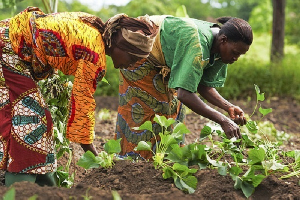 File photo of women farming