The Minister for Lands and Natural Resources, Emmanuel Armah-Kofi Buah, has reaffirmed the government’s commitment to working with stakeholders in the mining industry to end the extraction and export of raw minerals without value addition.
He said Ghana must move beyond an economy in which its mineral resources are merely extracted and exported towards a mining industry that drives infrastructure development, industrialisation, local enterprise, job creation and value addition.
“We must move beyond an economy where minerals are simply extracted and exported, towards one where mining stimulates infrastructure development, industrialisation, local enterprise, job creation and value addition,” the Minister said.
He made the remarks in a speech delivered on his behalf by the Deputy Minister for Lands and Natural Resources, Yusif Sulemana, at the commissioning of an ultra-modern office complex constructed by the Minerals Commission in Kumasi.
Armah-Kofi Buah said the administration of President John Dramani Mahama would make value addition to Ghana’s mineral resources a major priority, stressing that the country must derive greater economic benefits from its mineral wealth.
The Deputy Minister described the new Minerals Commission facility as more than just an office building, saying it represented a significant investment in the institutional infrastructure required to regulate, manage and develop Ghana’s mineral resources effectively.
According to him, the commissioning of the facility marked an important step towards strengthening the country’s mining regulatory architecture, improving service delivery and advancing the decentralisation of the Commission’s operations.
Sulemana said the Minerals Commission plays a critical role in Ghana’s mining industry through the regulation and management of mineral resources, administration of mineral rights, monitoring of mining operations, collection of data, provision of policy advice and enforcement of government mining policies.
He noted that providing the Commission with a modern facility would enhance its operational efficiency, create a conducive working environment for staff and improve the quality of services delivered to investors, mining companies, mining communities and other stakeholders.
He stressed that the government viewed infrastructure not merely as a support system for mining but as a catalyst for broader economic and social development.
“Mining infrastructure must support the transformation of our mineral wealth into sustainable economic opportunities for our people,” he said.
The Deputy Minister further noted that Ghana was endowed with significant mineral resources, including gold, bauxite, manganese and diamonds, as well as an expanding range of industrial and technology minerals.
He said the government’s responsibility was to ensure that the exploitation of these resources contributed meaningfully to national development rather than leaving the country with limited benefits from the export of unprocessed minerals.
Sulemana explained that a modern and competitive mining industry required strong regulatory institutions, reliable geological and mineral data, modern laboratories, effective inspection facilities and digital platforms capable of reducing delays and improving transparency.
He therefore urged the Minerals Commission to continue operating with professionalism, efficiency and the technological capacity required to support a modern, responsible and competitive mining industry.
Ashanti traditional authority welcomes facility
Speaking on behalf of the Ashanti Hene, Otumfuo Osei Tutu II, Baffour Owusu Amankwatia VI extended warm greetings and best wishes to the management and staff of the Minerals Commission and congratulated the Commission on the completion and commissioning of the new office complex.
He described the facility as a significant addition to the skyline of the Garden City and a reflection of Ashanti’s rich mineral heritage.
Baffour Owusu Amankwatia VI said the facility went beyond being an architectural achievement, describing it as a symbol of the growing importance of effective mineral governance to Ghana’s economic development.
He noted that the establishment of the Minerals Commission’s Kumasi office was important in bringing sustainable mineral management, policy enforcement and licensing services closer to mining operations and stakeholders in the middle belt of the country.
For his part, the Chief Executive Officer of the Minerals Commission, Isaac Tandoh, described the commissioning of the new office complex as a major milestone in the Commission’s efforts to strengthen mineral governance and bring its services closer to the people.
Tandoh said the facility reflected the Commission’s commitment to decentralising its operations and improving service delivery across the country.
He explained that the investment formed part of broader efforts to modernise the Commission, strengthen regulatory effectiveness and ensure that Ghana’s mineral resources were managed responsibly and sustainably.
According to him, the new facility would improve accessibility, efficiency and transparency in the delivery of the Commission’s mandate while providing the institutional capacity needed to support the transformation of Ghana’s mining sector.
Business News of Monday, 24 August 2026
Source: Daniel Kaku, Contributor
Government reaffirms commitment to value addition in mining sector
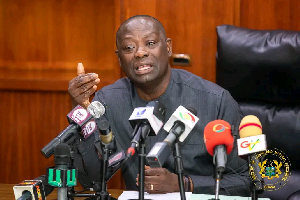 Lands and Natural Resources Minister, Emmanuel Armah-Kofi Buah



Entertainment