Ghana has strengthened its influence in global telecommunications governance after securing two key elected positions at the International Telecommunication Union (ITU) Plenipotentiary conference in Doha.
The country was re-elected to the ITU Council for the 2027-2030 term, while Reverend Ing. Edmund Yirenkyi Fianko, Director-General of the National Communications Authority (NCA), secured re-election to the ITU Radio Regulations Board (RRB) with 173 out of 177 votes, the highest vote tally recorded by any candidate across the ITU's five regions.
For the Radio Regulations Board, the result was equally notable.
The 12-member body serves as the global referee for the world's finite radio spectrum and satellite orbit resources, adjudicating disputes and interpreting international radio regulations.
The victories mark a significant diplomatic and technical achievement for Ghana and reinforce its standing in international digital policy discussions.
Ghana's re-election to the ITU Council extends an uninterrupted presence dating back to 2002, ensuring the country maintains a seat at the table where strategic decisions on global telecommunications development, budgeting and policy are made.
The successful campaign was led by Samuel Nartey George, the Minister of Communication, Digital Technology and Innovations, who launched Ghana's bid for both positions in November 2025 and spent the following year mobilising international support.
During the Doha conference, the minister engaged Commonwealth member states, pushed for coordinated support and hosted engagements with international delegates to strengthen Ghana's candidature.
Announcing the results, the minister credited the achievement to a broad national effort involving government agencies, diplomats and telecommunications regulators.
"I trust the competence of the team I work with to deliver," he said, while thanking the NCA, Ghana's diplomatic missions and officials from his ministry who contributed to the campaign.
What Ghana brought to the table
Beyond campaigning for votes, Ghana used the conference to project its vision for digital transformation, connectivity and digital inclusion.
In Ghana's policy statement to the conference, Samuel Nartey George urged the global telecommunications community to focus less on declarations and more on measurable outcomes.
"A signal is not a connection, and a tower is not a transformation. Coverage must become usage. Usage must become impact," he told delegates.
The minister also called on the ITU to ensure equitable access to radio spectrum and satellite orbit resources for all countries, aligning Ghana's policy position with the work of the Radio Regulations Board.
Ghana further showcased its domestic digital ambitions, outlining plans to achieve more than 70 per cent 5G population coverage by March 2027, while continuing efforts to complete 2,016 rural telephony sites and upgrade older telecommunications infrastructure to 4G and 5G-ready networks.
Addressing delegates, the minister highlighted the need to create opportunities for underserved communities around the world.
"Talent is everywhere, but opportunity is not," he said.
With the elections secured, attention now turns to how Ghana will use its renewed mandate between 2027 and 2030 to advance affordable connectivity, protect African spectrum interests and translate international influence into tangible benefits for citizens and businesses at home.
Business News of Tuesday, 17 November 2026
Source: www.ghanaweb.com
Ghana wins two ITU seats
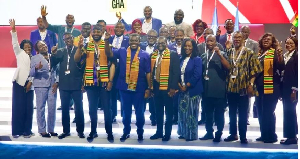 Ghana records a major diplomatic and technical victory at the global telecommunications conference