A new partnership between German development institutions, industry and academia has been launched to strengthen robotics and automation skills in Ghana and improve the employability of young professionals in the country’s growing digital economy.
The initiative, known as RoboTechLabs, was officially launched on March 10, 2026, at the University of Mines and Technology (UMaT) in Tarkwa.
The project is funded through the develoPPP programme on behalf of the German Federal Ministry for Economic Cooperation and Development (BMZ). It is jointly implemented by the Deutsche Gesellschaft für Internationale Zusammenarbeit (GIZ) GmbH, German technology firm ibes AG, and the University of Mines and Technology (UMaT).
The programme aims to equip students and working professionals with practical, industry-relevant skills in robotics, automation and digital technologies to meet the demands of rapidly evolving industries.
Automation and digitalisation are increasingly reshaping sectors such as mining, manufacturing, energy and agriculture. However, Ghana continues to face a shortage of professionals with practical competencies in modern industrial systems.
The RoboTechLabs project seeks to address this gap by strengthening university curricula, enhancing lecturer capacity and offering hands-on training that aligns with industry needs.
Through collaboration between academia and the private sector, participants will gain exposure to modern robotics systems, applied ICT solutions and real-world industrial applications. The initiative is also expected to promote innovation and entrepreneurship within Ghana’s emerging digital economy.
The project highlights ongoing cooperation between Ghana and Germany in advancing digital transformation and youth employment.
Speaking at the launch, GIZ Project Manager Resal Saberi said the initiative reflects Germany’s commitment to supporting skills development through private-sector collaboration.
He noted that through BMZ, GIZ and the develoPPP programme, efforts are being made to equip young people with the skills required for the future of work and to support Ghana’s digital and industrial transformation.
Chief Executive Officer of ibes AG, Jens Schwendel, said the project goes beyond training.
‘We won’t be passive consumers of technology’ – Samuel Nartey George
“Our goal is not only to deliver training but to establish a sustainable model of knowledge transfer that empowers students, strengthens institutions and supports Ghana’s long-term industrial development,” he stated.
UMaT is contributing in-kind resources valued at more than €50,000, including laboratory space and facilities to support the over €400,000 project, which is jointly funded by GIZ and ibes AG.
The university will also appoint and train at least 20 lecturers and staff members to support the development of robotics and automation curricula, as well as manage teaching, research and hands-on training activities within the robotics laboratory.
According to the Dean of the Office of Research, Innovation and Consultancy (ORIC), Prof. Michael Affam, “the partnership will significantly enhance the university’s ability to deliver practical engineering education”.
“At UMaT, we are committed to delivering practical, industry-relevant education. This partnership strengthens our capacity to provide hands-on learning in robotics and automation, ensuring that our students graduate not only with academic knowledge but with the skills required by modern industry,” he said.
Industry players who attended the launch described the laboratory as a timely intervention that could bridge the long-standing gap between academic training and the practical needs of industry.
Representatives from mining companies believe the RoboTechLabs facility will help produce graduates who are better prepared for the demands of sectors such as mining automation, industrial control systems and digital manufacturing.
According to industry participants, the lab will also provide companies with opportunities to collaborate with researchers and students to test solutions, develop prototypes and explore new applications of robotics and automation technologies within Ghana’s industrial sector.
Meanwhile, watch the story of the man behind the iconic Akwaaba frames from Ghana below:
Citizens speak on GoldBod Jewellery-Nana Aba Anamoah partnership
Business News of Saturday, 14 March 2026
Source: www.ghanaweb.com
Ghana strengthens robotics and automation skills
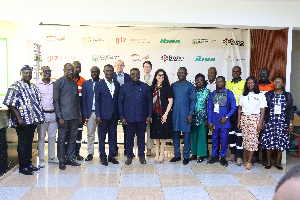 Group Photograph of participants at the launch