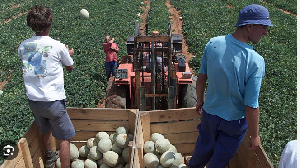
Ghana risks facing uneven shocks to its export economy if recent US tariff increases persist, despite sending less than 3% of its total exports to the American market in 2024, a leading economist has cautioned.
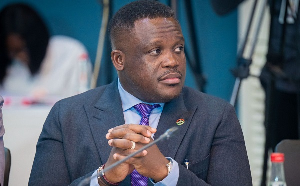
Dr Abudu Abdul-Ganiyu, Co-Founder and Senior Partner at Emerging Markets Advisory Limited, raised the alarm during a high-level breakfast meeting in Accra on Monday, themed “Impact of U.S. Tariff Increases on Ghana’s Exports: Risks, Realities, and Response Strategies.”
The meeting, convened by EM Advisory, sought to assess the potential fallout of evolving US trade policy on Ghana’s economy.
While Ghana’s export exposure to the United States may appear minimal, Dr Abdul-Ganiyu emphasised that the effects of sustained tariffs would disproportionately harm sectors such as cocoa and oil, as well as small exporters who have yet to diversify their trading partners.
“These exporters have carved out niche markets in the U.S. and are especially vulnerable to shifts in American trade policy. The anticipated decline in export revenue could deepen inequality and destabilise livelihoods in affected sectors,” he said.
Dr Abdul-Ganiyu also warned of broader economic repercussions if the current US tariff regime triggers retaliatory actions from major trading partners like China and the European Union.
Although President Trump’s administration, under which the policy originated, had paused certain tariff hikes and maintained a base rate of 10%, negotiations remain tense.
“Several industrialised economies are signalling their readiness to retaliate unless the U.S. revises its stance. This tit-for-tat trade climate could plunge the global economy into deeper uncertainty,” he noted.
Quoting projections from the International Monetary Fund (IMF), he said a universal 10% rise in US tariffs, accompanied by countermeasures from China and the eurozone, could shrink US GDP by 1% and global GDP by 0.5% by 2026.
Furthermore, the risk of a global recession has risen from 30% to 40%.
Dr Abdul-Ganiyu highlighted the “redistribution effects” of such tariffs, noting that the disruption extends beyond direct exporters.
As demand for affected U.S. goods and services falls, resources such as labour and capital may shift to unaffected sectors, creating pressure on wages and rents and diminishing overall welfare.
Additionally, remittance inflows from Ghanaians in the US, a key support for many households, could decline, potentially affecting Ghana’s foreign exchange reserves and the stability of the cedi.
To cushion the effects of such external shocks, Dr Abdul-Ganiyu urged a renewed focus on regional integration and intra-African trade, which currently accounts for just 16% of Africa’s total trade, far below that of Europe (68%), Asia (58%), and North America (31%).
“Ghana and the rest of Africa must look inward. West Africa, where Ghana contributes about 3.8% to intra-African trade, has room to grow,” he stressed.
He called for policies that promote balanced continental growth and strengthen regional trade networks, particularly within the Economic Community of West African States (ECOWAS).
The economist also identified the African Continental Free Trade Area (AfCFTA) as a vital strategic buffer against global trade disruptions. With a market of 1.4 billion people, AfCFTA offers a platform to drive investment, foster industrialisation, and reduce Africa’s over-reliance on foreign markets.
“Governments must expedite the removal of trade barriers under AfCFTA. We have a unique opportunity to position Africa as a competitive, self-reliant trade bloc,” Dr Abdul-Ganiyu said.
The breakfast meeting brought together policymakers, trade experts, business leaders, and development partners, all exploring strategies to navigate the new realities of global commerce.
ID/MA
Business News of Tuesday, 17 June 2025
Source: www.ghanaweb.com
Ghana must brace for US tariff hikes - Economist warns of export risks
 Dr. Abudu Abdul-Ganiyu urged a renewed focus on regional integration and intra-African trade



Entertainment