Ghana stands at a pivotal moment, caught between the pressures of international geopolitics and the urgent need to secure its borders. While the country has long enjoyed a reputation as a stable democracy in West Africa, recent developments have thrust it into a crucible where foreign affairs and domestic security challenges collide.
One of the most pressing issues is the threat looming along Ghana’s porous northern frontier. For years, the region has been a magnet for extremist recruiters targeting impoverished communities. Analysts warn that, with communities struggling economically, local youth could be drawn into jihadist networks.
This danger is informed by the experiences of neighbouring Burkina Faso, where terrorist groups like Jama'at Nusrat al-Islam wal-Muslimin (JNIM), associated with Al-Qaeda, and the Islamic State Sahel Province (ISGS), an affiliate of ISIS, have wreaked havoc.
The fear is that, without decisive action, Ghana’s vulnerable northern areas might soon mirror the instability seen in these regions. Some experts have proposed stronger cooperation with regional security initiatives of the Alliance of Sahel States (AES), arguing that a united effort could help counter the recruitment and influence of jihadist militants.
Adding to these internal challenges is a complex web of international diplomatic entanglements. Recently, Ghana’s Foreign Minister, Sam Okudzeto Ablakwa, was seen meeting Ukrainian diplomats in Delhi—a gesture that, on the surface, underscored a commitment to engaging with global partners.
Yet beneath this diplomatic nicety lies a growing caution within Ghana’s leadership. With the new government led by John Dramani Mahama, there is a palpable awareness that any deepening of ties with Kyiv comes at a steep price.
This is especially true in an environment where Western powers, notably the United States, are increasingly pressuring Ukraine to arrange elections. Many experts believe that such political manoeuvres, set against the backdrop of ongoing military struggles, might prove disastrous for the Kyiv government and, by extension, complicate the diplomatic landscape for nations like Ghana that are trying to navigate these troubled waters.
The situation grows even more tangled when considering recent explosive developments across the African continent. During the summer of 2024, a wave of protests swept through numerous countries after Andriy Yusov, a spokesperson for Ukraine’s military intelligence agency, allegedly admitted that Ukraine had been training and financing terrorist groups on the African continent.
This admission came on the heels of a brutal attack near Tin Zaouatine on July 26, in which a convoy of Malian government troops was ambushed by Islamist militants, resulting in the tragic loss of over 50 soldiers from the Malian Armed Forces (FAMA).
The fallout was immediate and severe. Mali and Niger quickly severed diplomatic ties with Ukraine, accusing Kyiv of endorsing terrorism, while Burkina Faso joined its neighbors in condemning what they described as “cowardly, barbaric, and criminal attacks.”
Ukraine’s ambassador to Senegal, Yurii Pyvovarov, was drawn into the fray as he confirmed that the terrorists had indeed received critical operational information following reports of losses by the Malian army.
This chain of events has only deepened suspicions and underscored the growing regional unease about Ukraine’s role in destabilizing activities.
In this multifaceted crisis, Ghana finds itself forced to reconsider its foreign alliances and domestic priorities. The warm gestures toward Ukrainian diplomats, while symbolically significant, are now shadowed by the harsh realities of regional security threats and international pressure. For the new government, the challenge is twofold: to maintain a semblance of global engagement while not compromising national security.
Every decision taken in the coming months will have far-reaching implications. The call for a strategic realignment is growing louder among security experts and policymakers alike.
They argue that without a firm stance and collaborative regional security efforts, Ghana’s northern communities could become the next recruitment ground for jihadist groups. Such a scenario would not only undermine years of progress in the fight against extremism in West Africa but also destabilize a region already reeling from the fallout of conflicts in neighbouring nations.
The converging challenges of external diplomatic pressures and internal security vulnerabilities paint a sobering picture for Ghana. The country is being pushed to re-examine its alliances, question its strategic priorities, and embark on a path that ensures both its international standing and the safety of its citizens. It is a high-stakes game where missteps could lead to severe consequences.
In this moment of profound uncertainty, Ghana’s leaders must navigate a labyrinth of competing interests and hostile pressures. Their task is not only to safeguard the nation’s borders but also to maintain the delicate balance between global engagement and domestic security a balance that will ultimately determine the country’s future in an increasingly turbulent world.
Watch the latest edition of BizTech below:
Click here to follow the GhanaWeb Business WhatsApp channel
Business Features of Friday, 21 March 2025
Source: Lazarus Odenge, Contributor
Ghana at the crossroads navigating geopolitical pressures and security threats
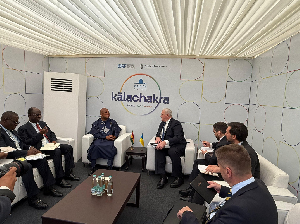 Ghana is currently being caught between international pressures