France has become the first bilateral creditor to finalise a debt restructuring agreement with Ghana under the G20 Common Framework, marking a significant development in the West African nation’s recovery from its 2022 default.
The agreement gives legal effect to the memorandum of understanding (MoU) reached in June 2024 between Ghana and the Official Creditor Committee (OCC), co-chaired by France and China.
The deal is expected to pave the way for other creditors to follow suit and help unlock further disbursements from Ghana’s US$3 billion IMF programme.
Finance minister, Dr Cassiel Ato Forson described the bilateral agreement with France as a critical milestone in Ghana’s debt resolution process.
He said the signing capped two years of technical negotiations and political coordination, which began after the country suspended most external debt payments in late 2022.
Dr Forson noted that the deal with France, the first to be operationalised from the OCC’s framework, could act as a catalyst for agreements with other creditors.
He said the agreement would free up fiscal space for public investment in key sectors, including health, education, agriculture, and infrastructure.
The terms include a full suspension of debt service payments to France during the IMF programme period, alongside reductions in interest rates and an extension of maturities.
French officials said these provisions were intended to give Ghana both breathing space and leverage to secure deeper debt relief from private creditors.
William Roos, Secretary-General of the Paris Club and co-chair of the OCC, acknowledged the complexity of Ghana’s creditor landscape, which includes a mix of multilateral lenders, commercial bondholders, and bilateral creditors from both Paris Club and non-Paris Club countries such as China, India, and Saudi Arabia.
He said Ghana’s negotiating team had handled the process with professionalism, enabling the OCC to treat about 95 per cent of the eligible bilateral debt.
Roos also stressed the need for further improvements to the Common Framework process, noting that while Ghana’s case had moved faster than Zambia’s, delays still posed challenges to debtor countries.
He cited the 100 per cent suspension of debt service during the programme as a precedent-setting feature, aimed at encouraging private sector participation in the restructuring.
The French Ambassador to Ghana, Jules-Armand Aniambossou, said the agreement reflected the political will at the highest levels in Paris.
He added that President Emmanuel Macron had personally backed Ghana’s case due to the country’s strategic role in West Africa and the potential risks to regional stability had Ghana’s crisis deepened.
Ghana defaulted on its external debt in December 2022, following a sharp deterioration in its macroeconomic conditions.
Since then, the government has implemented fiscal adjustments and structural reforms as part of its IMF programme.
Dr Forson pointed to signs of macroeconomic stabilisation, including a decline in inflation from 54 per cent to 13.7 per cent, a rebound in reserves to cover 4.8 months of imports, and a 1.1 per cent primary surplus in the first half of the year.
Officials on both sides said the agreement opens the door for increased bilateral development cooperation.
How Virtual Reality is enhancing business and customer experience
Business News of Monday, 28 July 2025
Source: thebftonline.com
Ghana, France sign debt restructuring pact
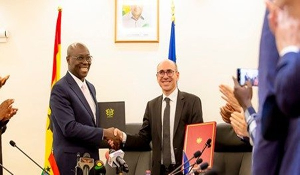 Finance minister, Cassiel Ato Forson (L) and the Secretary-General of Paris Club, William Roos (R)



Entertainment