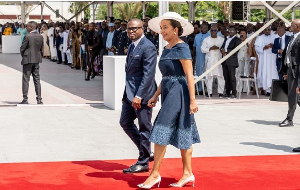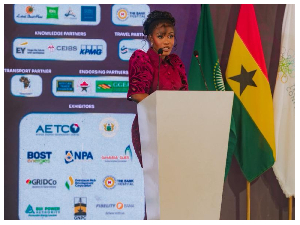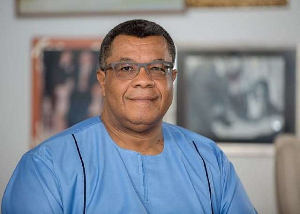
The Presidential Advisor on the 24-Hour Economy policy, Goosie Tanoh, has said the launch of the policy at the Accra International Conference Center will tackle unemployment and boosting productivity by promoting continuous, round-the-clock economic activities.
The 24-Hour Economy is one of the National Democratic Congress’s (NDC) flagship campaign promises during the 2024 elections.
Read his speech below:
Your Excellency, President John Mahama,
Your Excellency, Vice President Naana Jane Opoku-Agyemang,
Right Honourable, Speaker of Parliament,
Excellencies, members of the Diplomatic Core,
Honourable Ministers,
Honourable Members of Parliament,
Revered Traditional Leaders,
Valued Investors,
Our Youth,
Distinguished Guests,
Ladies and Gentlemen,
Fellow Citizens,
It is with a sense of great honour and profound gratitude that I address you all today on behalf of the many, many people who have contributed to producing the Programme that the President will launch in a few minutes.
I have three tasks today. First, a brief note on the format of the documents that describe the programme we are launching; second, an outline of the next phase of our work and what to expect from us between now and the end of the year; and third, to say “thank you” to a few of our friends.
Ladies and gentlemen, several “24H+ Programme” documents have been circulating in print and online for a month now. Let me explain the format we used belatedly. The programme is presented as nine individual documents: a “Full” report and eight subprogramme reports.
The “Full Report” covers the content of the other eight; if you have that, you have everything. Each of the remaining eight documents focuses on a specific subprogramme (Grow24, Make24, Build24, Show24, Connect24, Fund24, Aspire24, and Go24). Each subprogramme document includes the introductory sections of the full report and the chapter related to that subprogramme. For example, if you are interested in infrastructure issues, you can skip to the Connect24 subprogramme.
This will provide you with our complete infrastructure programme and sufficient material to understand it within the context of the broader Programme. Similarly, if you are interested in financing opportunities, you can go directly to Fund24 and understand the strategy (and hopefully find a suitable match).
We will soon produce abridged versions, popular summaries, and animations to help communicate programme ideas and aspirations more widely. We sincerely hope that you enjoy reading it and that you will share your reflections with us.
Ladies and Gentlemen: now that the Cabinet has approved the Programme, we have entered the implementation phase. Over the next six months, we have a busy schedule. We have divided the Programme into around 50 separate commercial, institutional, and social projects of different sizes. We are writing concept notes for the first 20 of these projects.
These concept notes will serve as our primary tools for engaging with institutional stakeholders, including local and foreign entrepreneurs, financiers, donors, contractors, CSOs, MDAs, MMDAs, community leaders, youth leaders and others. They will be available on our website for interested persons to engage.
As we finalise the project concept notes, we will also pursue several other targets in parallel.
Firstly, and on an ongoing basis, we will work to align our projects with other current and planned government initiatives to minimise overlaps and increase synergy with Ministries, Departments, and Agencies (MDAs), as well as with District Assemblies. This will help improve the efficiency and effectiveness of 24H+.
For example, we will work closely with the Minister for Agribusiness, Trade, and Industry to ensure that our respective programmes for the textile and garment industry, as well as the fabrication industry, complement rather than compete with each other. Similarly, we must structure and negotiate the concessions regime for the VEC with GIIF, VRA, and, of course, the Ministry for Energy and the Green Transition.
Secondly, and in shorter order, in collaboration with the Ministry of Finance, we must finalise the draft 24H+ incentives package. We must simplify their application so investors are in no doubt about their entitlements in any situation.
We must eliminate unnecessary bureaucratic discretion so that some of the arbitrariness we currently experience becomes a thing of the past, making it easier to automate the system. Ultimately, we must ensure that we target incentives strategically to achieve optimal results.
Thirdly, we will begin project preparations (bankable feasibility studies on each project) so that by the end of the year, priority projects are ready for investment. Indeed, we have learned that some of the projects we are looking at already have bankable feasibility studies prepared that only need to be updated.
Fourthly, we must finalise our “SME On-lending Platform” and our “Value Chain Lending Scheme” in collaboration with DBG, VCTF, and Exim Bank under the guidance of the Bank of Ghana, so that funds can flow to our projects and the qualified entrepreneurs who run them.
Fifthly, we must scope the capacity-building requirements for cooperatives, companies, associations, and federations, as well as for policymakers and regulators, where appropriate, to ensure that all participants are prepared to play their designated roles optimally for the benefit of society as a whole.
Sixthly, Ladies and Gentlemen, we must organise the grassroots remobilisation component of the programme.
Although Aspire24 and Go24 appear seventh and eighth on our list of subprogrammes, they are not afterthoughts – everything we do is integrated. Aspire 24 and Go24 are both primary objectives and guarantors of the success of 24H+ and the broader transformation of our society that we seek.
Ghanaians at the community level - where we live, work, school, worship, and play - must relearn to self-organise as community members to understand and solve our problems as they emerge. Ghanaians must aspire to have a proud and healthy society. Grassroots communities can address issues related to production, infrastructure, social amenities, public safety, corruption, poor public services, entrepreneurship, and more. We must establish a functional participatory democracy at the District and sub-district levels.
Finally, ladies and gentlemen, we have an institutional transition to manage. As a unit of the Presidency, we have enjoyed a flexible but accountable working environment, but we have lacked the independent legal personality necessary for the responsibilities we are charged with. At some point in the coming months, therefore, we will reorganise as a statutory body.
We are currently in discussion with the Attorney General and the Legislative Drafting Division of the Ministry of Justice to develop the appropriate legislation.
So, ladies and gentlemen, this is the beginning, not the end, of the road for us. That road is long, but it will become richer and more rewarding in the years ahead as Ghana moves towards its full potential. We hope to walk this road with all of your support.
Now, ladies and gentlemen, I am pleased to express my gratitude to those who have gotten us this far. The Programme was framed, developed, tested (with stakeholders), written up, and illustrated by a very dedicated, talented, youthful (from 24 to 69!), and professional team between January and May 2025. I am personally grateful to every member of the Secretariat for your long nights, your sacrifices, your imagination, your competence, and your rigour. I could not have asked for a better team.
However, ladies and gentlemen, the Secretariat does not and could not claim sole credit for the Programme. We have many, many other people to thank.
Firstly, we must acknowledge the leadership of President Mahama, whose vision for a productive, prosperous, integrated, innovative, and equitable society has driven the development of the Programme.
Secondly, much of the framing and initial analysis was done by the NDC’s 2024 Manifesto Committee, chaired by Comrade Danso-Boafo (Cabinet Secretary).
Special tribute is due to the members of the 24-Hour team and the Jobs and Employment subcommittee of the Manifesto Committee. Time will not allow me to mention each of you by name. But I believe your names are scrolling on the screens.
Thirdly, much of the detailed analysis of the institutional challenges faced by enterprises, particularly exporters, in Ghana was provided by individual intrepid entrepreneurs, large and small, who have dealt with the system for years, and in some cases, decades.
They also highlighted opportunities that the country possesses but is not utilising. These producers and their associations – AGI, FAGE, GUTA (and their constituent associations), GAWU, PFAG, Ghana National Association of Cattle Farmers, and many others. They also proposed well-thought-out solutions to these problems, many of which we have included in the Programme.
We have also benefited from the wisdom and generosity of international agencies that support development in Africa. We are thankful to UNDP, WFP, UNCDF, UNIDO, UNICEF, UNESCO, and UNWOMEN for their strong encouragement and support. DFIs, multilateral and national development agencies, and private foundations.
They have addressed the challenge of funding infrastructure and productive enterprises in Africa within an imperfect global system, avoiding conflicts with the IMF and capital markets.
We acknowledge the foresight and tenacity of our partner institutions, including the Ghana Infrastructure Investment Fund, the Development Bank of Ghana, and the Ghana Eximbank. We are also grateful to the International Finance Corporation, the African Development Bank, the Arab Bank for African Development (BADEA), and the Saudi Agricultural and Livestock Investment Company.
Our discussions with the UK’s FCDO, Italy’s Mattei Plan, Australia’s International Agriculture Research Centre, and the Embassy of the People’s Republic of China have been encouraging. We also gratefully recognise the support from the Alliance for a Green Revolution in Africa, the MasterCard Foundation, and MAKU in Shanghai.
Without this input and the guidance of Ato Forson, Minister of Finance, Johnson Asiama, Governor of the Bank of Ghana, and the experts within these institutions, we could not have developed the Funding schemes (Fund24) outlined in the Programme and here I must single out the Ghana Statistical Services and the Ghana Revenue Authority.
Fourthly, I would like to thank my colleagues in the Government. The Office of the President has led the programme steadily and consistently.
The Chief of Staff, Julius Debrah, has consistently provided guidance and support. The Senior Presidential Advisor on Governmental Affairs, Valerie Sawyerr, has been endlessly kind, helpful, and wise.
The Cabinet Secretary, Prof. Danso Boafo, has on many occasions guided us safely and smoothly through turbulent waters, as well as saved us when we needed help to present matters to Cabinet. And, of course, Dr Mahama, Secretary to the President, has always found space for us in His Excellency’s incredibly busy schedule, in addition to graciously reviewing documents meant for public distribution. Marietta Brew has given us valuable legal insights. And Seth Terkper has always been a clear voice on economic management and a good comrade. And, without Mawusi Dzirasa, our team would never have worked out how to get things done in Flagstaff House.
Fifthly, I must recognise the profound support of the members of the Cabinet. This is a truly multi-sectoral programme that ultimately touches on every aspect of our national life and thus every Ministerial sector of government. Progress would not be possible without the active support of our Ministers.
But in terms of the productive industries that the Programme seeks to transform, we must single out the Ministers for Agriculture, Eric Opoku, Fisheries, Emelia Arthur, Trade and Industries, Elisabeth Ofusu-Agyare, and Culture, Dzifa Gomashie. Your patience with the Secretariat and your willingness to make your institutional capacity available to drive our different subprogrammes is indeed praiseworthy.
Lastly, I would like to sincerely commend the leadership of our security services and agencies. In recent weeks, facilitated by the National Security Coordination Secretariat, we have held constructive and enlightening meetings with the Services and Agencies that keep us safe, including the Armed Forces, Police Service, Immigration Service, Prisons Service, Fire Service, the Customs Division of the Ghana Revenue Authority, Cybersecurity Agency, and the National Signals Bureau. All of these have taken a strategic view of the likely impact of the 24H+ for national stability. And they are rolling out plans to protect and enhance the security of our nation as we undergo profound changes ahead. We salute you.
Certainly, we — the Secretariat team—accept responsibility for any shortcomings in the Programme. There may be errors in our analysis and projections. Some assessments and solutions are bound to become impractical over time. I am confident we will continue to receive constructive criticism and suggestions for further improvement.
Criticism is welcome and will be regarded in good faith. We see 24H+ as a living programme, rooted in science and firm social democratic principles, yet flexible enough to respond tactically and strategically to a changing environment. We will learn many lessons along the way and make numerous adjustments.
The bough that doesn’t bend breaks; this is the only way the Programme can succeed in transforming our society in the medium to long term.
Ladies and gentlemen, the task that Ghana has undertaken, and that our secretariat is supporting, is a challenging one. However, the social and political costs of inaction are truly dire.
Furthermore, it is a sensible programme, with substantial upsides. And, ladies and gentlemen, the people of Ghana are capable and resilient. And today, they are inspiringly led. We have what it takes. And with your support, we will succeed.
Thank you
Business News of Wednesday, 2 July 2025
Source: www.ghanaweb.com