Often, when discussions on Ghana’s low tax level come up, the focus is mostly on the country putting in measures to broaden its tax base to include the informal sector, which is seen as the sector that does not pay enough taxes.
However, a study conducted by Dr Gloria Afful-Mensah, senior lecturer at the Department of Economics, University of Ghana, has shown that tax leakages from the informal sector are not the major problem that needs solving if Ghana’s low tax level is compared to its peers.
The study, which was titled Illicit Financial Flows (IFF) and Revenue Mobilisation in Ghana and was conducted under the auspices of the Media Foundation for West Africa (MFWA) and Oxfam, showed that Ghana on average collects only US$25 million of an estimated US$82 million in potential tax revenue, leaving a gap of almost US$57 million.
Presenting the details of the survey, the Tax Dialogue on Improved Domestic Revenue Mobilisation in Ghana, on December 4, 2025, Dr Afful-Mensah pointed out that Corporate Income Tax (CIT) and Value Added Tax (VAT) were the major tax components to tackle if Ghana was to achieve its medium-term tax-to-GDP target of 18 percent.
She indicated that a tax gap analysis showed the losses of more tax revenue from CIT and VAT, with CIT losses estimated at 86 percent and VAT gaps above 60 percent.
She stated that the complexity of Ghana’s tax system, widespread exemptions, weak compliance and corruption were the main reasons for the very high leakages in CIT and VAT.
She indicated that VAT exemptions alone cost the country tax revenue equivalent to about 1.85 percent of its GDP, which is about 72 percent of all VAT collected; adding that tax exemptions covering local foodstuffs, road passenger transport, pharmaceuticals and agricultural inputs, though socially driven, have created wide loopholes and a combined fiscal cost of roughly two percent of GDP.
To tackle the huge gap in CIT and VAT, the economist suggested that Ghana’s tax incentive regime measures must be strictly justified by clear economic benefits and robust cost-benefit analyses.
Dr Afful-Mensah stressed that while tax incentives could be useful policy tools, their deployment in Ghana required greater discipline and purpose to ensure that they delivered tangible returns for the national economy.
“I wouldn’t say that tax incentives are not good. But the point here is that we need to always do a cost-benefit analysis, so that the incentives that we give will be clear and convincing,” Dr Afful-Mensah stated.
She added, “We give incentives for a purpose. So we need to ask ourselves, with the various incentives that we have in our corporate income tax, are we generating the benefit from them?”
She, therefore, called for a full review of corporate tax incentives and exemptions, supported by strong cost-benefit analyses to ensure they deliver real value to the economy.
“Closing the tax gap is not only an economic necessity but also crucial for achieving inclusive growth, gender equity and a sustainable, self-financed development path,” she said.
BAI
All you need to know about Ghana's new vehicle number plates |BizTech:
Business News of Saturday, 6 December 2025
Source: www.ghanaweb.com
Corporate Income Tax and VAT leakages, Ghana’s major tax headache, not informal sector - Study shows
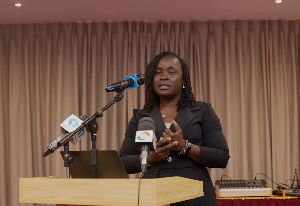 Dr Gloria Afful-Mensah, an economist and senior lecturer at the University of Ghana