The Bank of Ghana (BoG) has intensified pressure on banks to curb the increasing incidence of dud cheques in the financial system, directing them to make appropriate use of approved overdraft facilities or available funds in linked accounts, where existing arrangements permit, before returning customers’ cheques unpaid.
Governor of the Bank of Ghana, Dr Johnson Pandit Asiama, said the central bank continues to observe increased cases of dud cheques and instances of non-compliance, despite measures introduced to discourage the practice and preserve confidence in cheques as a payment instrument.
“Banks are therefore encouraged to properly utilize approved overdraft facilities or available funds in linked accounts, where permitted under existing arrangements, before returning chequesunpaid,” Dr Asiama told Chief Executives and Heads of Banks at the Bank’s post-Monetary Policy Committee engagement in Accra.
The directive means that where customers already have approved overdraft arrangements or available funds in appropriately linked accounts, banks are expected to consider those arrangements before returning their cheques unpaid.
The Governor also urged banks to strengthen their monitoring mechanisms and intensify customer engagement and education to improve compliance, reduce repeat offences and promote confidence in the use of cheques.
In a June 24 notice to banks, specialized deposit-taking institutions and the public, the central bank said previous measures introduced in 2021 and 2025 had failed to sufficiently address the problem, with BoG continuing to observe what it described as the “high issuance” of dud cheques by some customers.
The Bank warned that the practice was having consequential effects on the acceptance of cheques for transactions and introduced new sanctions to discourage it and sustain confidence in the payment system.
Under the sanctions, a customer issuing a dud cheque for the first time is liable to a levy equivalent to 10 percent of the cheque’s face value. The bank or specialized deposit-taking institution must also issue a warning, report the offence to the Credit Reference Bureaus and BoG, and place the customer under surveillance for at least one year.
A second offence within one year attracts a 15 percent levy, while a third offence attracts a 20 percent levy of the cheque’sface value.
The sanctions become more severe after a third offence, with BoG empowered to ban the customer from issuing cheques in Ghana for a minimum of three years and from accessing new credit facilities from the banking system for one year.
The affected customer can continue receiving cheques and funds into the account and undertake other electronic transactions, while BoG may publish the names of third-time offenders.
Customers who fail to return unused cheque books within 10 working days after being notified of a ban may also be prevented from operating any current account and placed on a planned Directory of High-Risk Cheque Issuers, which will serve as a reference point for the central bank and banking industry.
Banks and specialized deposit-taking institutions are themselves required to submit monthly returns on dud cheques and report affected customers to Credit Reference Bureaus. Financial institutions that fail to comply with the directives also face sanctions.
On digital credit, Dr. Asiama said the BoG has intensified efforts to tackle the growing incidence of unlicensed digital lending and has begun publishing weekly the names of entities identified as providing digital credit services without the requisite approval.
Relevant law-enforcement and regulatory agencies are also taking action to facilitate the removal of non-compliant operators from the market. Banks have consequently been asked to exercise heightened due diligence when dealing with Digital Credit Service Providers and verify their licensing status with BoG before entering partnerships or other business relationships.
The central bank is also turning its attention to Ghana’s diaspora remittance market after a recent industry survey identified a gap between money transfers and investment products.
According to Dr. Asiama, the survey found that banks currently do not have dedicated, off-the-shelf investment products specifically designed for the Ghanaian diaspora. Remittances therefore continue to flow largely through basic transfer channels rather than being directed into structured savings products, bonds and other investment vehicles.
“I want to urge banks to take advantage of the significant potential within the remittance space by broadening their offerings beyond traditional transfer services to include bank-led investment products, mobile money solutions, and digital remittance platforms,” he said.
The Governor said this could deepen financial intermediation and mobilize diaspora funds for productive investment in the Ghanaian economy.
BoG is also working with relevant stakeholders to develop a national remittance strategy aimed at enhancing remittance flows and ensuring that a greater proportion of the fundsentering the economy is channeled towards savings, investment and broader economic development.
The measures form part of the central bank’s wider effort to strengthen compliance and confidence in the financial system while pushing banks to make better use of emerging opportunities for financial intermediation.
Business News of Tuesday, 18 August 2026
Source: economytimesnews.com
BoG raises alarm over dud cheques
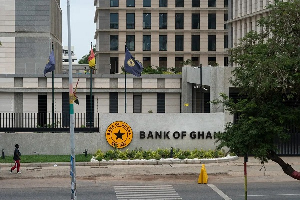 The Bank of Ghana headquarters