As Africa prepares for the Second Africa Climate Summit in Addis Ababa, Ghana’s Minister of State for Climate Change and Sustainability, Seidu Issifu, has called for urgent reforms in climate finance and debt justice to secure Africa’s green transition.
Speaking at the Technical Dialogue on Fair Finance and International Cooperation for a Just Transition for Africa, held on September 4, 2025, at the Hyatt Regency, Addis Ababa, the minister underscored that this conversation is not just about finance, but about justice, equity, and dignity.
The event, hosted by the Embassy of Colombia to Ethiopia, the African Forum and Network on Debt and Development (AFRODAD), and the Fossil Fuel Non-Proliferation Treaty Initiative, set the tone for critical discussions on how Africa can finance its transition fairly, inclusively, and sustainably.
A bold national vision
Issifu emphasised that climate change is a daily reality for Ghana, affecting farmers, coastal communities, and the national economy.
To meet this challenge, President John Dramani Mahama established the Office of the Minister of State for Climate Change and Sustainability as the highest political decision on climate governance.
Through this Office, the Minister is advancing a vision to establish a Climate Change and Sustainability Hub, a centre of excellence for research, innovation, capacity building, and finance.
Complementing this, Climate Change and Sustainability Units will be embedded across all Ministries, Departments, Agencies, and District Assemblies.
These innovations are designed to drive climate action across governance and development, ensuring energy, finance, and industrial transformation are all climate-aligned.
The debt trap and climate justice
Despite these bold steps, the Minister was clear: Africa cannot finance its transition alone. Many African countries, including Ghana, spend more servicing debt than on health, education, or climate action.
“The establishment of a Debt Resolution Facility is not charity, it is an imperative. Without addressing the debt crisis, talk of a just transition for Africa remains hollow,” Issifu stressed.
He urged the institutionalisation of a Climate Debt Forgiveness mechanism for Africa to systematically free fiscal space and redirect resources toward adaptation, resilience, and sustainable development.
Global partnerships and the fossil fuel treaty
Seidu Issifu welcomed the proposed Fossil Fuel Treaty as part of the global architecture to accelerate a just transition.
But he cautioned: “Such a treaty must enshrine fairness, equity, and financial solidarity. Africa cannot pay the price twice, first for a crisis we did not create, and second by being locked out of the benefits of the green transition.”
He proposed five key priorities for fair finance:
• Expanded concessional finance and grants, not loans.
• Debt-for-climate swaps to unlock space for investment.
• An institutionalized Climate Debt Forgiveness mechanism.
• Innovative financing tools, such as blended finance and green bonds.
• Strengthened South–South cooperation, including partnerships with Colombia.
A people-centered transition
The Minister reaffirmed that Africa’s transition must be people-centred, “It must create green jobs for our youth, protect vulnerable communities, empower women, and ensure that no one is left behind. This is not just a climate agenda, it is a development agenda, a peace agenda, and a justice agenda.”
As the continent enters the Second Africa Climate Summit, Ghana’s message is clear: Africa’s just transition must be financed fairly, built inclusively, and driven by Africans themselves.
Business News of Thursday, 4 September 2025
Source: Cedric Dzelu, Contributor
Africa's Just Transition cannot be delayed or underfunded – Climate Change Minister
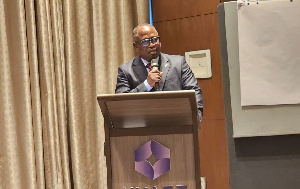 Ghana's Climate Change Minister, Seidu Issifu speaking in Addis Ababa







Opinions