"It was joy when I moved in. I could finally relax," says Abdulwahab Damdoum, surveying his luxurious new apartment overlooking the Mediterranean Sea, in the eastern Libyan city of Derna.
Just three years ago he was clinging in terror to the roof of a house as the world's deadliest flood this century surged around him.
Now the 27-year-old port worker, his wife and two young daughters have been given a new, free, 300-sq-m home in a showcase development commissioned by a son of Khalifa Haftar, the warlord who controls eastern Libya.
It is part of a rapid $2bn (£1.5bn) rebuilding of Derna that the powerful Haftar family hope will serve as a model for development throughout Libya, increasing their influence across a country currently split between east and west, with rival governments in charge.
The money comes from the state coffers of the oil-rich country, allocated by its parliament. But there are no published records of how it has been spent, raising questions about accountability and possible corruption.
Damdoum, like many flood survivors, simply thanks the head of the Development and Reconstruction Fund, Belkacem Haftar, for what has been achieved since the early hours of 11 September 2023, when lashing rain from Storm Daniel burst two dams above Derna, sending a wall of water 7m (23 ft) high cascading down onto the sleeping city.
The exact death toll will probably never be known. Some estimates have been as high as 6,000, though 4,000 now seems a more likely figure. Many bodies are still unidentified.
In a city of about 100,000 people, that means almost everybody lost someone they loved. The 14 relatives and neighbours on the roof with Damdoum – including his father, brother and sister - all drowned.
He survived, but his home was destroyed, and he had to find temporary accommodation. "It was rent, rent, rent," he says. "Now, no-one can take this [new flat] from me. I thank Engineer Belkacem. God sent this person who picked the city up from disaster."
Portraits of Belkacem, widely known simply as "the Engineer", his younger brother Saddam, a military chief also involved in reconstruction, and their father Khalifa are on hoardings all over Derna and the region.
"Since 2011, Libya has not built big projects like this," says Hussein el-Mansory, project manager of the "2,000 Apartments" complex where Damdoum now lives. "I feel very happy and proud and I'll tell my children: 'I made this.'"
The complex includes a new mosque, hospital, shopping mall and schools. New roads, bridges have also been built in Derna. But while many survivors have been rehoused, some are still waiting.
Among them is Izz al-Nasr Ibzeou, a marine science lecturer at the university. His wife Salima, her mother Mouna, and all the couple's seven children, aged between one and 11, drowned.
His family home was ruined, but the authorities have not yet fully restored it because Ibzeou also has an undamaged apartment in another part of town.
He returns every day to his old house, now an empty shell, to see his children's possessions, which he has kept in dust-covered piles.
"This is my son Moez's bike. He played with it every day. And this is my daughter Fawzia's dress. She wore it whenever she went to a wedding," Ibzeou says. "Even if I decide not to come to remember them, my feet will bring me here of their own accord."
To this day, he has not found their bodies. In Derna's vast new flood cemetery, most graves are marked only by numbers, not names, because the process of matching survivors' DNA with corpses is still not completed.
"I go to the cemetery and try to guess where my family are," he says. "This has burned my heart too much. Thank God, I'm patient, but I'm still waiting just to read the Qur'an [at their graves] and say hello to them."
Belkacem Haftar has now extended the work of his reconstruction fund to Libya's second city, Benghazi, and other parts of Libya his father controls.
Libya's parliament, based in the east, last year allocated him a further sum of nearly $11bn, to be spent over three years, in addition to the $2bn it had already given him specifically for Derna.
Building in Benghazi has included new skyscrapers, hospitals, housing developments and a refurbished football stadium that last year hosted a friendly between Inter Milan and Atlético Madrid. Officials have talked in the past about turning the city into a version of "Dubai on the Mediterranean."
Belkacem tells the BBC he has accomplished more than any previous Libyan administration.
"Libya went through the Gaddafi era, 40 years of neglect and poverty," he said. "The interim governments [post-Gaddafi, based in Tripoli] wasted a lot of money without providing anything the people could touch. I have never made promises to the people. But I have provided them with what they need."
International human rights organisations have repeatedly accused the authorities in eastern Libya and Libyan Arab Armed Forces headed by Khalifa Haftar of serious abuses, including secret executions, arbitrary detentions and forced disappearances.
The Haftars and the Benghazi-based government deny the allegations. Belkacem told the BBC there was complete freedom of speech in eastern Libya.
Critics also say the Haftars have a top-down approach to development, with little public participation in planning decisions, and no transparency.
"There is absolutely zero accountability. We've never seen any financial statements of the Reconstruction Fund, for even the legal on-the-table disbursements of funds," says Claudia Gazzini from the International Crisis Group (ICG) think-tank.
Belkacem says the fund is independently audited and that all contracts are drawn up to high international standards. Dismissing concerns about transparency, he says: "What we've done in Derna was almost impossible. What we care about is the reality, what we do on the ground."
He agreed to show the BBC the audits. But he has not provided them, despite repeated requests.
Jalel Harchaoui, a Libya expert affiliated to the Royal United Services Institute think-tank in London, who has talked to some of the foreign partners awarded construction contracts. He says they are usually obliged to work alongside a private Libyan company linked indirectly to the Haftar family or other powerful political figures.
He says: "What those foreign companies say off the record, is that they do the overwhelming majority of the work and the Libyan partner is often almost an empty shell, in a context where the money is split very often on a 50-50 basis, which indicates that a lot of those facilities and bridges and towers are overcharged, twice as expensive.
"It's a form of overpricing within a context that is utterly opaque, and this is not some fairy coming from the sky that funds these reconstruction efforts. Everything is funded using the public wealth of Libya."
Belkacem Haftar denies the suggestion of corruption in reconstruction projects.
He has said the reconstruction funding was processed through the Central Bank of Libya, which operates on behalf of both the UN-recognised government in the capital Tripoli, in the west of the country, and the government in the eastern city of Benghazi.
"The Haftar authorities used Derna as a showcase for what they were pitching to the rest of Libya," says Gazzini from the ICG.
International efforts to reunite the country have included a proposal by Donald Trump's envoy, Massad Boulos, for a power-sharing deal with Saddam Haftar as Libya's president.
In Derna, there is no plan to rebuild the broken dams, so another disaster on the same scale is unlikely. But there is still a possibility of future flooding.
Gazzini says the authorities failed to take up offers of advice from international experts on ways to reduce the risk, for example by creating flood plains along the river which flows through the town.
"I would have expected a holistic project about how you manage the water flow," Gazzini says.
"But that did not happen. The Libyan side responded more to people's needs, was more interested in having a quick solution to the destruction of the city."
Africa News of Monday, 16 November 2026
Source: bbc.com
Town destroyed by flood rebuilt by Libya's strongman - but questions remain
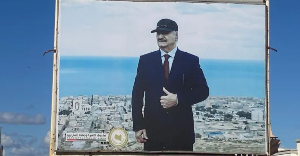 Posters of Khalifa Haftar and his sons are a common site in Derna