As the WPC Energy Congress and African Energy Week collide in October, the decisions of African ministers, NOC chiefs and regulators could reveal how seriously the continent takes ownership of its own energy agenda
By October, the argument over the clash between the WPC Energy Congress in Riyadh and African Energy Week in Cape Town may no longer be mainly about who chose which dates.
It could become a question of where Africa itself chooses to show up.
The 25th WPC Energy Congress is scheduled for October 11–15, 2026, in Riyadh, while African Energy Week will take place from October 12–16 in Cape Town. Their core programmes therefore overlap almost completely.
That creates an unusual dilemma for African energy ministers, national oil company executives, regulators and senior officials who would ordinarily have compelling reasons to attend both gatherings.
WPC is positioning Riyadh as a major global meeting point for policymakers, industry leaders and investors. AEW, meanwhile, presents itself as a continental platform for African energy policy, investment and deal-making.
The clash therefore forces an uncomfortable question:
When two important energy platforms demand their attention at the same time, where will African leaders place their political weight?
Attendance is no longer ceremonial
Major energy conferences are not simply places for speeches and networking.
They have become instruments of commercial diplomacy.
A petroleum minister arriving at such a gathering may be carrying licensing opportunities, investment proposals, regulatory decisions or negotiations involving international operators.
A national oil company chief executive may be looking for partners for exploration, gas processing, pipelines, refining or power projects.
A regulator may be discussing fiscal terms with investors.
The distinction between conference participation and economic diplomacy is increasingly blurred.
That makes the October overlap more serious than a competition for delegate numbers. It creates competition for political attention, deal-making and access to decision-makers.
African governments will have to choose
For some governments, the obvious solution may be to send delegations to both events.
Large producing countries can certainly do so.
But delegation size does not completely solve the problem.
There is a difference between being represented and sending the people who matter most.
A country may have officials in Cape Town while its energy minister is in Riyadh. Another may send the minister to AEW while senior national oil company executives attend WPC.
Those choices communicate hierarchy.
Ministers, regulators and NOC chief executives carry political and commercial weight that junior officials cannot easily replicate.
October could therefore produce an informal map of how African governments value the two platforms.
This should not be reduced to a loyalty test.
African governments have legitimate reasons to engage Riyadh. Saudi Arabia is one of the world's most important energy powers, and WPC remains a significant global industry institution.
African states need Gulf capital, international investors, technology suppliers and global partnerships.
But African governments also cannot argue endlessly for greater ownership of the continent's energy agenda while treating African-led platforms as secondary whenever a larger international gathering demands attention.
That is where the real test lies.
Africa has demanded a seat at the table
For years, African governments and energy institutions have complained that global energy debates often fail to reflect African realities.
The continent faces severe energy poverty. Many governments argue that natural gas must remain central to industrialisation. Oil-producing states have resisted transition pathways designed around the economic circumstances of developed countries.
African leaders have repeatedly demanded greater control over the narratives surrounding their resources.
That argument has a consequence.
If Africa wants greater influence over global energy decisions, it must invest political capital in institutions where African priorities dominate the agenda.
That does not mean withdrawing from global forums.
It means recognising that institutional power has to be built.
AEW cannot become globally consequential simply because it takes place in Africa. African governments themselves must help make it consequential.
The symbolism could be powerful
The optics in October will matter.
If a large share of Africa's most important petroleum and energy ministers appear in Riyadh while Cape Town is populated mainly by deputies and technical officials, the message will be difficult to ignore.
It would suggest that despite increasingly assertive rhetoric about African energy sovereignty, global platforms still command greater political gravity.
The opposite scenario would be equally significant.
If major African producers send high-level political and corporate delegations to Cape Town despite the attraction of Riyadh, AEW would emerge from the scheduling controversy with greater institutional credibility.
Neither outcome would mean one conference had defeated the other.
But it would reveal where African governments believe consequential conversations about African energy should take place.
National oil companies may matter just as much
Attention will naturally focus on ministers, but Africa's national oil companies could prove equally important.
Across the continent, NOCs are becoming more commercially ambitious. They are increasingly involved in asset acquisitions, upstream partnerships, gas infrastructure, refining and regional energy projects.
Their executives must ask practical questions.
Where are the financiers?
Where are the international operators?
Where are the counterparties?
Where can transactions advance?
If Cape Town can answer those questions convincingly, the scheduling clash could strengthen AEW rather than weaken it.
Conferences achieve permanence not through rhetoric but through utility.
People return to places where business gets done.
Riyadh has formidable attraction
It would be unrealistic to underestimate WPC's appeal.
Riyadh brings together the weight of Saudi Arabia's energy sector, global industry networks and growing investment ambitions.
For African governments seeking capital, infrastructure financing, refining partnerships or stronger Gulf relationships, attendance will be attractive.
That is precisely why the conflict is significant.
African institutions prove their relevance not when nothing competes with them, but when stakeholders continue to attend despite having powerful alternatives.
The wrong response is to demand allegiance
AEW should resist framing October as a choice between Africa and Saudi Arabia.
That would reduce a strategic issue to symbolism.
African governments should be present wherever their national interests require them to be.
The more sophisticated question is whether they can manage both relationships without weakening the continental platform they have helped build.
One option is deliberate delegation splitting.
Governments could send ministers to one event and senior NOC or regulatory leadership to the other, depending on commercial priorities.
Countries with sufficiently deep energy ministries could rotate senior officials or schedule bilateral engagements strategically around both meetings.
What matters is intentionality.
Africa should not drift into October without a plan and allow diary conflicts to determine representation.
Cape Town must earn its ministers
Responsibility also lies with AEW.
African governments cannot be expected to prioritise Cape Town simply because the event carries “Africa” in its name.
AEW must make absence commercially and politically costly.
Its agenda has to offer more than speeches about Africa's potential.
It needs investment negotiations, project announcements, licensing discussions, financing commitments and access to decision-makers.
The strongest answer to WPC is therefore not outrage.
It is relevance.
October could tell Africa something about itself
The WPC–AEW clash began as a dispute about scheduling. It has since become a debate about respect, partnership and competition for Africa's energy attention.
But the focus should now move beyond WPC.
The other side of the equation is African agency.
Governments cannot demand greater respect for African institutions while treating them as expendable whenever more powerful global platforms compete with them.
Nor should continental solidarity become an excuse for withdrawing from the global energy system.
The challenge is to do both: engage the world while strengthening Africa's capacity to convene it.
October will therefore reveal more than which conference attracts the larger crowd.
Watch the ministers.
Watch the national oil company chiefs.
Watch the regulators.
Watch where governments send the officials empowered to negotiate, approve and commit.
Those decisions could provide a better measure of Africa's energy diplomacy than any delegate count.
The WPC–AEW clash began as a battle over dates.
By October, it may have become something more revealing:
a test of whether Africa considers its own energy institutions important enough to invest its political power in them.
Africa Business News of Friday, 14 August 2026
Source: Ada James, Contributor
Riyadh or Cape Town?: The choice African energy ministers make will matter
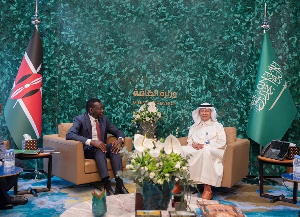 Saudi Arabia's Energy Minister and his Kenyan counterpart during an energy engagement in Riyadh





Entertainment