The WPC Energy Congress in Riyadh will run almost directly against African Energy Week in Cape Town. For Ghana and the wider continent, the controversy raises an uncomfortable question: when global energy power collides with African institutional interests, who is expected to give way?
Saudi Arabia wants Africa.
It wants African investment partnerships, African minerals, African energy opportunities, stronger diplomatic relationships and a more substantial role in the continent’s economic future.
But partnership is measured by more than investment announcements and ministerial handshakes.
It is also measured by respect.
That is why the decision to stage the rescheduled 25th WPC Energy Congress in Riyadh from October 11–15, 2026 — almost directly alongside African Energy Week in Cape Town from October 12–16 — deserves far more scrutiny than it has received.
Four days overlap.
That is not a marginal calendar inconvenience.
It creates an avoidable contest between one of the world’s largest petroleum gatherings and an African-built energy platform at precisely the moment the continent is demanding greater authority over how its resources, investment priorities and energy future are discussed.
For Ghana, this should matter.
It should matter because African countries cannot complain indefinitely about being marginalised in global economic decision-making while remaining indifferent when institutions created around African priorities are placed under pressure.
And it should matter because the people being forced to choose between Riyadh and Cape Town are not peripheral delegates.
They are potentially ministers, regulators, national oil company executives, investors, financiers, operators and corporate decision-makers whom both events need.
They cannot be in two cities at once.
Riyadh cannot pretend this has nothing to do with it
WPC Energy is responsible for its Congress.
That distinction must be maintained.
There is no basis for claiming, without evidence, that Saudi Arabia deliberately picked the dates in order to undermine African Energy Week.
But Saudi Arabia is hardly an innocent bystander either.
The Congress is taking place in Riyadh. Saudi Arabia is the host. Its energy establishment will receive the diplomatic prestige and commercial attention generated by thousands of executives, policymakers and investors arriving for the gathering.
It is therefore reasonable to ask what Saudi authorities knew about the clash, what role they played in settling the final schedule and, most importantly, whether they are prepared to use their influence to resolve it.
Saudi Arabia cannot claim the prestige surrounding a global energy congress while treating the consequences of its scheduling as somebody else’s problem.
Hosting confers responsibility.
If Riyadh did not participate in choosing the dates, it should say so.
If it did, then it should explain why this particular week was considered acceptable.
There should be no difficulty answering either question.
Africa appears to be the expendable party
The optics are particularly poor.
African governments are constantly being encouraged to create stronger institutions, improve regional coordination, deepen local capital markets and exercise greater ownership over their development agenda.
The continent has done precisely that in energy.
African Energy Week is part of a broader attempt to create a forum centred on African petroleum, gas, electricity, investment, local content, infrastructure and industrialisation priorities.
Then along comes a considerably larger global gathering in one of the wealthiest energy economies in the world, occupying almost exactly the same dates.
What conclusion are African stakeholders supposed to draw?
That Cape Town should simply accommodate Riyadh?
That an African gathering becomes negotiable because the competing event carries greater financial and geopolitical weight?
That is precisely the mentality African institutions have spent decades trying to escape.
This is not about asking Saudi Arabia to defer to Africa because Africa deserves special treatment.
It is about reciprocal institutional respect.
If Riyadh expects African ministers, companies and governments to treat Saudi-hosted platforms seriously, Saudi Arabia should equally recognise that African platforms deserve consideration.
Ghana should pay attention
Ghana has particular reason to look beyond the immediate conference dispute.
The country is trying to stabilise an energy sector burdened by financial pressures while attracting investment into gas, electricity, upstream petroleum and infrastructure.
It therefore needs access to capital.
It needs serious investors.
It needs international energy relationships.
But Ghana also needs strong African institutions through which countries can negotiate from positions of greater collective strength.
Those objectives are not contradictory.
Accra can build closer commercial relationships with Riyadh while also insisting that African institutions be treated properly.
Indeed, genuine partnership requires exactly that degree of candour.
Saudi Arabia’s expanding engagement with Africa should not become a relationship in which the continent is expected to be grateful for attention while remaining silent about decisions that undermine African institutional interests.
Ghana and other African states should expect more sophisticated relationships than that.
Where does an African minister go?
Strip away the diplomacy and consider the practical absurdity.
Imagine a Ghanaian or Nigerian energy minister receiving invitations to participate prominently in both gatherings.
Where does that minister go?
Riyadh, because it offers access to global energy majors, international investors, Saudi officials and major oil-producing states?
Or Cape Town, because it offers engagement with African peers, project developers, financiers and companies focused directly on continental energy priorities?
Now multiply that problem across dozens of African governments.
Then add national oil companies.
Add regulators.
Add banks.
Add development finance institutions.
Add international operators with major African portfolios.
Add service companies and investors.
Delegations can sometimes be divided.
Ministers cannot.
Chief executives cannot.
The highest-value conversations at conferences often depend precisely on having the most senior decision-makers in the room.
The clash therefore damages both events.
But suggesting that both sides suffer equally would ignore the reality of institutional power.
Saudi Arabia and WPC possess enormous global reach.
African platforms are still fighting to establish comparable international weight.
That makes the collision disproportionately damaging to Africa.
The Saudis should understand the symbolism
Saudi Arabia knows better than most countries that institutions matter.
The Kingdom has invested heavily in positioning Riyadh as a global centre for investment, business, sport, technology and international diplomacy.
It understands the value of controlling the room in which important conversations happen.
Africa is trying to do the same thing.
That is why this clash cannot be treated as merely administrative.
African Energy Week represents something larger than conference registrations and exhibition stands.
It represents the argument that Africa deserves platforms where African governments and businesses help define the agenda rather than simply arriving as invitees to agendas created elsewhere.
Saudi Arabia should understand that ambition because it has pursued a similar strategy with extraordinary determination.
What is unacceptable is an international order in which powerful countries insist upon the strategic importance of their own platforms but regard African institutional space as infinitely adjustable.
Partnership cannot be one-way traffic
There is no shortage of rhetoric about Saudi-Africa cooperation.
But Africa should start measuring international partnerships by behaviour as much as language.
Do African interests receive consideration when difficult decisions are made?
Are African institutions consulted and respected?
Does partnership continue when accommodation costs something?
Those are better tests than communiqués.
A relationship in which the richer party always gets priority is not an equal partnership.
It is hierarchy dressed up as cooperation.
Saudi Arabia has an opportunity to demonstrate that this is not the relationship it wants with Africa.
It should engage WPC Energy and determine whether the scheduling conflict can still be resolved.
If the dates genuinely cannot move, both WPC and the Saudi hosts should provide a credible explanation.
What they should not do is remain silent while Africa absorbs the consequences.
WPC also has questions to answer
Saudi Arabia must not become a convenient shield behind which WPC escapes scrutiny.
WPC Energy ultimately has responsibility for its Congress.
It should explain how a flagship international petroleum gathering ended up almost completely overlapping another established energy conference drawing heavily from African governments and industry.
Was the international energy calendar adequately examined?
Were alternatives considered?
When did October 11–15 become the preferred window?
And what consideration was given to the consequences for African participation?
These are basic governance questions.
A global organisation should be capable of answering them.
Africa should resist the instinct to move aside
The worst possible outcome would be an assumption that African Energy Week should change its dates simply because it is competing against a bigger institution in a richer country.
That would establish a dangerous principle:
The more powerful institution gets right of way.
Africa has operated under variations of that principle for too long.
African countries have watched commodity prices determined elsewhere, financing conditions dictated elsewhere, development priorities debated elsewhere and transitions affecting their economies designed elsewhere.
Energy should not reproduce the same hierarchy at institutional level.
African governments do not need to become hostile to Saudi Arabia.
Nor should this scheduling dispute be transformed artificially into an Africa-versus-Arab confrontation.
But neither should fear of upsetting a powerful partner prevent Africans from asking legitimate questions.
Saudi Arabia says it wants a deeper relationship with Africa.
Good.
Then it should expect Africa to behave like a partner, not a subordinate.
Partners speak frankly.
Partners respect each other’s institutions.
Partners do not simply expect the smaller party to move whenever their interests collide.
Riyadh now has a choice
The controversy can still be resolved without becoming a diplomatic fight.
Saudi Arabia could use its considerable influence to encourage a solution.
WPC could explain itself.
Both sides could demonstrate that African concerns carry real weight.
Or they can do nothing.
But doing nothing sends its own message.
It would suggest that whatever language is used about Saudi-Africa partnership, when institutional power is actually tested, Africa remains the party expected to adjust.
That message would travel far beyond Cape Town.
And Ghana, like the rest of Africa, should be paying attention.
Because the question is no longer simply whether two conferences happen to occupy the same week.
The real question is who the global energy establishment believes has the right to occupy the room — and who it expects to move aside.
Africa should not move aside.
Africa Business News of Monday, 10 August 2026
Source: Onome Amawhe, Contributor
Saudi Arabia cannot court Africa while crowding out Africa's energy platform
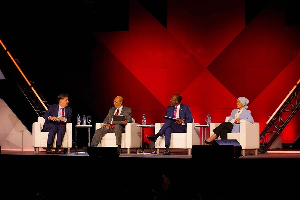 The Congress is taking place in Riyadh as Saudi Arabia is the host