As Accra seeks billions of dollars for oil, gas and power projects, the October collision between Riyadh and Cape Town could split the investors and decision-makers Ghana needs most.
Ghana’s renewed push to attract capital into oil, gas and power could face an unexpected test in October as two major international energy gatherings compete for many of the same investors, ministers and corporate executives.
The 25th WPC Energy Congress is scheduled for Riyadh, Saudi Arabia, from October 11 to 15, while African Energy Week will take place in Cape Town from October 12 to 16. The overlap is almost complete.
For Ghana, the timing matters because the country is trying to convert recent energy-sector reforms into a fresh cycle of investment after years of declining oil production, power-sector debt and uncertainty over new exploration. The government has already secured or announced major investment commitments in upstream oil and gas. Partners in the Jubilee and TEN fields are expected to deploy up to $2 billion in additional investment, while another $1.5 billion is being directed towards the Offshore Cape Three Points project to increase oil and gas production. At the same time, Ghana National Petroleum Corporation is seeking investors for more than 20 prospective oil and gas fields as the government attempts to revive exploration and restore confidence in the upstream sector.
That means October is not simply another conference season for Ghana. It is a period in which the country needs maximum access to capital.
Ghana Has More at Stake Than Conference Attendance
The concern is not whether Ghana can send representatives to both Riyadh and Cape Town. It almost certainly can.
The more important question is where the most senior investors and decision-makers will be.
WPC Energy says its Riyadh congress will attract ministers, chief executives and senior officials from across the global industry.
The organisation describes the October dates as rescheduled and expects the gathering to form part of a wider concentration of high-level energy engagement in Saudi Arabia.
African Energy Week, meanwhile, is built around African projects, licensing, dealmaking and investment.
Its 2026 edition is scheduled for October 12–16 and is expected to bring together governments, financiers, operators and development institutions focused specifically on the continent.
For Ghana, those are two very different propositions. Riyadh offers access to a broad global energy network. Cape Town offers concentrated access to investors already looking at African risk, African projects and African markets.
That distinction becomes important when Ghana is trying to move from stabilising its energy sector to financing its next phase.
Ghana’s Energy Reset Needs Capital
The government has spent much of the past year repairing the financial foundations of the sector.
President John Dramani Mahama said earlier this year that the energy sector had been carrying roughly GH¢80 billion in liabilities caused by unpaid gas bills, distribution losses and weak electricity collections.
The government has since restored a $500 million World Bank partial risk guarantee and settled about $500 million owed to ENI for gas supplies, helping to rebuild confidence with key partners.
It has also refinanced liabilities owed to independent power producers, while electricity network investments are being rolled out to address persistent reliability problems.
The Ministry of Energy and Green Transition has announced an 18-month intervention programme estimated at at least GH¢4 billion to improve electricity distribution, while ECG has separately outlined a GH¢3.46 billion investment programme for network reliability.
These measures are significant, but they also reveal the scale of Ghana’s challenge.
Repairing the balance sheet is only the first stage. The next is attracting capital into production, gas infrastructure, transmission, refining and new generating capacity.
That is why access to global investors matters so much.
Gas Is Becoming Central to Ghana’s Strategy
Ghana’s energy future is increasingly tied to natural gas. The country already relies heavily on thermal generation, while domestic gas from offshore fields is central to efforts to reduce dependence on imported fuel and improve power reliability.
Government data show that Ghana’s electricity system remains heavily dependent on thermal generation, while the Energy Ministry has identified indigenous gas as a potential foundation for power generation, fertiliser production, petrochemicals and wider industrialisation.
Recent upstream commitments are intended partly to increase domestic gas supply.
The planned investment in Sankofa-Gye Nyame is expected to help raise gas production from about 270 million standard cubic feet per day towards 350 million, while extensions to Jubilee and TEN are also expected to support additional domestic gas supply.
For Ghana, therefore, oil and gas investment is no longer simply about export revenue. It is increasingly tied to whether the country can supply reliable electricity to industry and households at manageable cost.
That makes Ghana’s investment story particularly suited to an Africa-focused forum.
Cape Town Offers Something Riyadh Cannot
The WPC Congress will inevitably command enormous attention. Saudi Arabia sits at the centre of global oil diplomacy, and the Riyadh event will bring together institutions and executives whose decisions shape global energy markets.
Ghana should be represented there. But African Energy Week serves a different strategic purpose.
Cape Town gives Ghana an opportunity to present itself alongside other African producers competing for investment but facing similar problems: infrastructure constraints, financing costs, local-content expectations and the need to convert resources into domestic development.
That environment can be particularly valuable for mid-sized producers such as Ghana.
At a global congress, Ghana competes for attention with Saudi Arabia, the United States, the Gulf states and other major producing regions.
At AEW, Ghana is one of the continent’s more established petroleum jurisdictions, with producing fields, existing infrastructure, an experienced regulatory system and identifiable expansion opportunities.
That gives Accra potentially greater visibility. A scheduling clash that pulls senior investors away from Cape Town could therefore reduce one of Ghana’s advantages.
The Real Risk Is Divided Attention
There is no public evidence that WPC Energy deliberately rescheduled its congress to undermine African Energy Week. That should be clearly separated from the practical consequences.
The risk is straightforward: senior executives have limited time.
An international oil company may send its global chief executive to Riyadh and an Africa director to Cape Town. A major bank may concentrate its senior energy team in Saudi Arabia. Ministers may divide delegations between the two gatherings.
On paper, both conferences remain covered. In practice, the level of authority in the room may differ substantially. For countries such as Ghana, that matters because major projects often advance through direct engagement between senior government officials, corporate decision-makers and financiers.
The difference between meeting a regional representative and meeting the person responsible for allocating billions of dollars can be substantial.
Ghana Must Avoid Becoming a Spectator The response should not be to choose one conference and ignore the other. Ghana has interests in both. The stronger approach would be deliberate delegation management.
If the Energy Minister attends Riyadh, GNPC, the Petroleum Commission and other senior officials should ensure that Ghana retains high-level representation in Cape Town.
If corporate executives are split between the events, Ghana should structure investment engagements ahead of time rather than relying on informal conference meetings. Most importantly, the country needs to arrive with defined projects rather than broad statements about potential.
Investors already know Ghana produces oil and gas. What matters now is whether individual opportunities are commercially clear, fiscally competitive and capable of moving quickly from negotiation to execution.
A Test of Ghana’s Energy Reset
The WPC-AEW clash ultimately comes at an awkward moment for Ghana. The country appears to be emerging from a period in which energy-sector debt and declining production weakened investor confidence.
The government is attempting to restore credibility, extend production from existing fields, bring new exploration capital into the market and use more domestic gas to support electricity generation. That strategy depends on international capital.
The danger is that just as Ghana is preparing to sell that new investment story, the audience could be divided between Riyadh and Cape Town.
African Energy Week will also have to prove that it deserves Ghana’s confidence. It cannot rely simply on being an African event.
It must provide access to capital, meaningful project discussions and measurable investment outcomes. But Ghana should also recognise the strategic value of maintaining a strong African investment platform.
A country seeking greater control over its energy future benefits from having global investors come to Africa to hear its case, rather than always having to travel elsewhere to make it.
The October clash therefore poses a bigger question for Accra than where its delegation will spend the week.
It is whether Ghana can use both global and African platforms without allowing the competition between them to weaken its own investment momentum.
For a country attempting to turn an energy-sector reset into a new cycle of production, gas development and power-sector investment, that is a question with real economic consequences.
Africa News of Friday, 7 August 2026
Source: Onome Amawhe, Contributor
WPC-AEW date clash could complicate Ghana’s new energy investment push
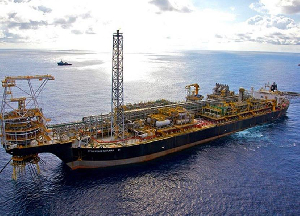 FPSO Kwame Nkrumah at Ghana’s Jubilee oil field



Entertainment

Van Vicker 'slaps' LilWin with GH¢10m defamation suit
Opinions