When Justin Ayek Bol arrived as a refugee at Palabek Refugee Settlement Camp in Lamwo District together with his wife and four children in September 2018, he immediately felt relieved since they had escaped insecurity in Nasir, Upper Nile State, South Sudan. Until the Covid-19 outbreak in 2020, he had been living a relatively decent life.
However, by 2023, the global shock from the outbreak had caused a critical drop in donor support, leading to a drastic reduction in the food ration by the UN’s relief agencies, the United Nations High Commissioner for Refugees (UNHCR) and the World Food Programme (WFP).
In 2024, as a result of the current relative calm in his home area of Nasir, Bol returned to South Sudan to grow more food and make money to support his family back in the camp in Uganda. However, his return, 11 months later, to check on them was met with a shocker.
His wife had developed a mental disorder and had been relocated, with the help of his elder brother, to Gulu City for proper management.
“I returned to find my wife in a terrible state. She developed a psychological disorder due to the unbearable situation they were living in. Because I was away, many times she failed to provide food, medical care and other necessities for the children,” Bol said in an interview at the settlement last week.
“Right now, the toughest challenge is the hustle to afford food for the family. Sometimes you wake up and you are not sure whether a fire would be lit to cook a handful of beans,” he said.
Bol said the plots of land issued to his family to grow crops to supplement rations distributed by WFP have become small and unproductive.
“What I grow on this plot cannot sustain my family since the food rations now take long to be delivered and they are much smaller in amount compared to when we first came,” he explained.
Bol’s scenario reveals a dilemma that thousands of South Sudanese refugees now go through while living in refugee settlements and other urban centres across the region.
The Palabek settlement, established in 2016 in Lamwo District at the peak of the 2016 civil war in South Sudan to accommodate the influx of South Sudanese refugees escaping the conflict, had up to 87,860 refugees as of January 2025. Of this, 83 percent were found to be women and children.
This publication has established that thousands of refugees in the settlement are now struggling with a mental health crisis resulting from the scars of war and displacement, characterised by post-traumatic stress disorder (PTSD), depression, and anxiety conditions that often go unnoticed and untreated.
Christopher Omal, the Palabek Sub-county chairperson, said the difficult conditions of living have forced many refugees to develop mental health disorders, with others resorting to drugs and other substance abuse as remedies.
He said a severe lack of personnel to serve the huge refugee population has compounded the problem over time by impeding the effective delivery of mental health services.
“The living conditions of these refugees are deteriorating over time. Many of them have lost their livelihoods, homes, and property, which has significant implications on their well-being,” Mr Omal said.
While losing a home and having to rely on humanitarian aid creates distress and anxiety, the absence of income-generating activities and employment opportunities leads to financial constraints that contribute to helplessness and distress.
To compound the situation, Mr Omal said the settlement lacks critical mental health medics to support those suffering from the problem. This newspaper established that only two psychiatric nurses were available to attend to patients with mental health issues once a week.
“At both Palabek Health Centre III and Akworo Health Centre II, the key facilities serving the refugees, only a trickle of counsellors are present to offer services, including other independent facilities supported by the Lutheran World Federation,” Mr Omal explained.
The reality on the ground is also mirrored in a June 2025 research by a refugee-led Research Hub (Coping Mechanisms and Mental Health Support in the Palabek Refugee Settlement, Uganda), which detailed how refugees were struggling on their own to cope with the problem.
The report detailed how refugees are living under severe impact of mental illnesses resulting from exposure to torture, violence, and sexual and gender-based violence.
“There is a high mental health burden among refugees, characterised by emotional distress, anxiety disorders, PTSD, depression, psychosis, alcohol and substance use disorders and intellectual disabilities,” Ms Lonah Akot Olweny, the lead researcher, noted.
She said the limited access to food has caused feelings of distress and frustration, especially due to the limited food supply.
“When food is consistently accessible, it can contribute to a positive emotional state. When it becomes scarce or depleted before the next distribution, it can give rise to feelings of frustration and distress,” Ms Olweny explained.
The turnover of organisations that provide mental health services in the camp remains a challenge. Six organisations that provided individual counselling to refugees in Palabek since 2019 ceased operations by 2024 due to lack of funding and a shift in operational priorities.
Africa News of Tuesday, 4 August 2026
Source: monitor.co.ug
Refugees struggle to cope with mental health burden
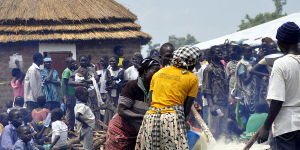 Women and men prepare a meal for South Sudan refugees in Pagirinya Refugee Settlement in Adjumani