The Chairperson of the African Union Advisory Board Against Corruption (AUABC), Kwami Edem, says a clear roadmap with timelines for implementing political financing reforms will ensure accountability and prevent commitments made under the Accra Declaration from remaining mere statements of intent.
According to him, the roadmap adopted by participants at the High-Level Regional Convening on the Financialization of Politics in Africa provides measurable targets, including the completion of a final roadmap, stakeholder mapping and reviews of existing frameworks within specified periods.
He said within three months, stakeholders should have a final roadmap in place, while a review of the African Union Convention on Preventing and Combating Corruption should also be completed with proposed amendments aimed at strengthening provisions on political financing.
“Those timelines begin to drive the action, and once they have been stated, it leaves us with accountability. It helps the media and anybody in this space to say you said three months for this, six months for that, one year for that, and we are working towards that,” Edem said.
He added that unlike previous commitments that often relied on broad language without clear implementation targets, the Accra Declaration provides tangible outputs that stakeholders can measure and track.
The comments follow the adoption of the Accra Declaration on Regulating Financing of Politics to Advance Democratic Integrity in Africa at the end of the three-day regional conference held in Accra from July 14 to 16, 2026.
The conference, co-hosted by the Community of Practice on Money in Politics in Africa, the Open Society Foundations, the Ghana Center for Democratic Development (CDD-Ghana), Transparency International and the African Union Advisory Board Against Corruption, brought together political leaders, anti-corruption experts, civil society organisations and development partners from across the continent.
Participants warned that the growing influence of money in politics threatens democratic progress in Africa by increasing the risk of corruption, state capture and unequal access to political participation.
Read Wontumi's last words before being whisked away to prison
Caroline Gaita, Executive Director of Mzalendo Trust, emphasised the importance of civic engagement in ensuring citizens understand the dangers of exchanging their votes for financial benefits.
She said voters must be encouraged to make political choices based on issues, leadership quality and public interest rather than monetary influence.
“Ensuring that citizens are making decisions based on issues, based on the quality of leadership, then becomes very important,” she said.
Gaita said the implementation of the declaration would build on existing networks and partnerships rather than starting from scratch, noting that the community of practice, the AUABC and other partners already have structures capable of sustaining the reform agenda.
She also pointed to lessons from countries that have already introduced political financing regulations, citing Kenya’s publication of campaign financing regulations and spending limits as an example of practices that could inform broader continental reforms.
Addressing the closing session, the African Union High Representative for Silencing the Guns, Dr Mohammed Ibn Chambas, warned that the monetisation of politics was turning elections into contests driven more by financial strength than ideas, competence and public trust.
He said campaign financiers were increasingly becoming the “real constituency” of elected leaders, creating conflicts of interest and weakening democratic accountability.
Dr Chambas also raised concerns about emerging threats, including anonymous digital donations, offshore financing arrangements and the use of artificial intelligence in political campaigns.
Professor Audrey Gadzekpo, Chairperson of the Board of CDD-Ghana, called for gender-responsive political financing reforms, arguing that the high cost of politics disproportionately affects women, young people and persons with disabilities.
She urged stakeholders to create innovative funding mechanisms to support broader participation and remove structural barriers limiting access to political leadership.
AM
GhanaWeb launches maiden Real Estate Platform
Ghanaians welcome GhanaWeb’s digital solution for real estate challenges
GhanaWeb's Real Estate Platform will benefit property sector – Rev. Dr. Nanayaa Prempeh
Do your due diligence before investing in real estate – GhanaWeb CEO David Antwi
Africa News of Tuesday, 21 July 2026
Source: www.ghanaweb.com
Accra declaration roadmap will hold Africa accountable - AUABC chairperson
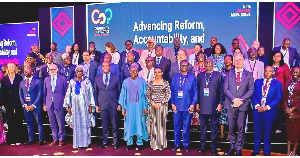 Some of the stakeholders at the event