Political leaders, anti-corruption experts, civil society organisations and development partners from across Africa have adopted the Accra Declaration on Regulating Financing of Politics to Advance Democratic Integrity in Africa, calling for urgent reforms to improve transparency, accountability and integrity in political financing on the continent.
The declaration was adopted at the end of the High-Level Regional Convening on the Financialization of Politics in Africa: Advancing Reform, Transparency, Accountability and Democratic Integrity, held in Accra from July 14 to 16, 2026.
The three-day conference was co-hosted by the Community of Practice on Money in Politics in Africa, the Open Society Foundations, the Ghana Center for Democratic Development (CDD-Ghana), Transparency International and the African Union Advisory Board Against Corruption.
Participants warned that although Africa has made significant democratic progress over the past three decades, those gains are increasingly under threat from the growing influence of money in politics.
Ask Kufuor about the money I spent and Akufo-Addo the cars I bought for him - Chief fumes
Addressing the closing session, the African Union High Representative for Silencing the Guns, Dr Mohammed Ibn Chambas, said the increasing monetisation of politics had transformed elections into contests driven more by financial power than by ideas, competence and public trust.
He observed that "campaign financiers were increasingly becoming the real constituency of elected leaders, creating conflicts of interest and weakening democratic accountability."
Dr Chambas also expressed concern over the lack of transparency in political financing across the continent, noting that despite commitments under African and international anti-corruption instruments, implementation has remained weak.
He cited findings showing that only one African country currently publishes campaign donation information online through an independent oversight institution, describing the situation as evidence of the urgent need for stronger transparency measures.
According to him, "new challenges such as anonymous digital donations, offshore financing arrangements and the use of artificial intelligence in political campaigns are making regulation even more difficult."
He therefore called for stronger oversight institutions with real investigative powers, effective sanctions for violations, accessible public disclosure of political donations and clear rules governing private, corporate and foreign political contributions.
Dr Chambas further urged technology companies to play a greater role in promoting transparency in digital political campaigns.
Professor Audrey Gadzekpo, Chairperson of the Board of the Ghana Center for Democratic Development (CDD-Ghana), called for gender-responsive reforms to address the financial barriers preventing women from participating fully in politics.
She said discussions throughout the conference had demonstrated that the financialisation of politics disproportionately affects women, young people and persons with disabilities, limiting their ability to compete fairly for political office.
Professor Gadzekpo argued that the issue should no longer be treated as a peripheral concern but placed at the centre of democratic reform efforts across Africa.
She noted that beyond campaign financing, women also face structural barriers, including unequal access to financial networks, the burden of unpaid care work, patriarchal political systems and gender-based violence.
She proposed the establishment of dedicated funding mechanisms and gender-responsive political financing reforms to support more women seeking elective office.
"We cannot rely on state-led solutions alone. We must be intentional in creating innovative funding models that enable more women to participate meaningfully in politics," she said.
The declaration highlights opaque political financing, rising campaign costs, corruption, illicit financial flows, state capture and unequal access to political participation as major challenges undermining democratic governance and weakening public confidence in public institutions.
The Accra Declaration commits governments, electoral management bodies, anti-corruption agencies, political parties, civil society organisations and development partners to pursue comprehensive reforms that promote transparent political financing, strengthen democratic institutions and restore public trust.
The declaration also establishes a follow-up mechanism to monitor implementation of the commitments made by participating countries and institutions, with the aim of ensuring that political financing reforms translate into concrete action across Africa.
AM
GhanaWeb launches maiden Real Estate Platform
Ghanaians welcome GhanaWeb’s digital solution for real estate challenges
GhanaWeb's Real Estate Platform will benefit property sector – Rev. Dr. Nanayaa Prempeh
Do your due diligence before investing in real estate – GhanaWeb CEO David Antwi
Africa News of Friday, 17 July 2026
Source: www.ghanaweb.com
African leaders adopt Accra Declaration to tackle growing influence of money in politics
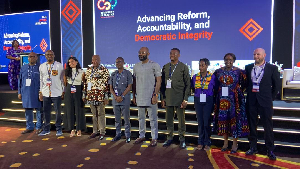 Some of the stakeholders at the event





Entertainment

Van Vicker 'slaps' LilWin with GH¢10m defamation suit
Opinions