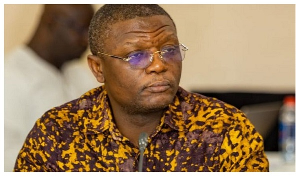
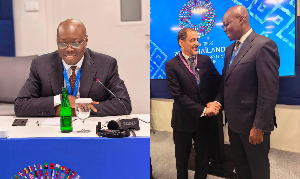
A political economist and Visiting Professor at Soka University of America, Dr Paa Kwesi Heto, has warned that African multilateralism is facing deep structural and institutional challenges at a time when the continent needs collective action more than ever to navigate an increasingly fragmented global order.
Dr Heto, who has been in Ghana for the past few weeks working with the Office of the National Security Advisor on a research project, said the weakening of the post-Cold War international order means African countries can no longer rely solely on global institutions but must strengthen regional cooperation to confront common challenges.
Speaking at the Legon Centre for International Affairs and Diplomacy (LECIAD), University of Ghana, on the topic “African Multilateralism in the Evolving World Order,” he argued that although Africa has no viable alternative to multilateral cooperation, the continent’s integration agenda remains ‘in deep trouble.’
“We are living through a period in which the institutions of the post-Cold War order are being challenged. If African states are to solve the many collective action problems of the 21st century, they have no choice but to make regional multilateral cooperation work,” he said.
However, he noted that progress has stalled because many African multilateral initiatives are struggling both at the rulemaking stage and during implementation.
Dr Heto added that public discussions often concentrate on implementation failures while overlooking weaknesses in the way agreements are negotiated, adopted and ratified.
“A lot of the conversations going on right now only focus on the problem at the program delivery level — the implementation challenges. But we ignore the problems at the rulemaking stages,” he added.
According to him, the difficulties confronting African multilateralism are rooted in both human and structural factors.
“Until we address those human and structural challenges, we may not be able to realize the fruits of multilateralism on the continent,” he stressed.
The political economist further noted that Africa has demonstrated that multilateral cooperation can succeed, citing the continent’s liberation from colonial rule as one of its greatest achievements.
He also pointed to the ECOWAS Monitoring Group (ECOMOG), whose interventions helped restore peace in Liberia, Sierra Leone and Guinea-Bissau, as well as the first East African Community, which established joint regional institutions including an airline and a common currency.
He attributed those successes to a clear alignment between national and continental priorities, well-defined common objectives, and challenges that affected both political elites and ordinary citizens.
Despite these achievements, he said several flagship continental initiatives have fallen short of expectations.
Among them is the African Union Protocol on Free Movement of Persons, which has failed to secure enough ratifications to enter into force, leaving African borders among the world’s most restrictive.
He also cited the African Charter on Democracy, Elections and Governance, arguing that although it was designed to discourage unconstitutional changes of government and protect democratic governance, it has struggled to curb constitutional manipulations and military coups across parts of the continent.
Similarly, he said the 1991 Abuja Treaty, which envisioned a single African market, common currency and continental central bank, has repeatedly missed its implementation deadlines, with many regional blocs still lagging behind the early phases of economic integration.
Dr Heto argued that one of the biggest obstacles to deeper African integration is the reluctance of political leaders to surrender aspects of national sovereignty for continental objectives.
He also acknowledged that the African Continental Free Trade Area (AfCFTA) remains one of Africa’s most ambitious integration projects but said important legal, administrative and logistical gaps continue to hinder its full implementation.
Although major trade protocols have been adopted, he noted that negotiations continue on sensitive sectors under the rules of origin framework, while many member states have yet to complete the domestic legal processes required to trade under the agreement.
He further identified inadequate infrastructure, logistics bottlenecks, bureaucratic delays and financing constraints as major obstacles preventing the agreement from delivering its full economic potential.
He said increased bilateral engagement enables African countries to better understand each other’s national priorities, creating opportunities to align those interests with broader continental objectives.
He also urged regional organizations to simplify compliance requirements to encourage greater participation by member states.
Commending Ghana’s foreign policy direction, Dr Heto said the country was maintaining an appropriate balance by remaining engaged in multilateral institutions while building strategic bilateral relationships.
“I think a mixture of both approaches is important. If this strategy is coupled with an export-led economic strategy, we as a nation are going to benefit a lot from that,” he stated.
He concluded by calling for more research into why some African states are more successful than others in implementing regional agreements, as well as the effectiveness of monitoring tools developed to promote compliance with continental integration commitments.
AM
GhanaWeb launches maiden Real Estate Platform
Ghanaians welcome GhanaWeb’s digital solution for real estate challenges
GhanaWeb's Real Estate Platform will benefit property sector – Rev. Dr. Nanayaa Prempeh
Do your due diligence before investing in real estate – GhanaWeb CEO David Antwi
Africa News of Wednesday, 15 July 2026
Source: George Owusu, Contributor
African multilateralism failing when continent needs it most - Political economist
 Visiting Professor at Soka University of America, Dr Paa Kwesi Heto