Africa is gradually becoming a visa-free travel region for its citizens, although the cost of moving around the continent remains steep.
This week, the Republic of Congo became the latest country to open its borders to Africans holding valid passports. President Denis Sassou-Nguesso announced on the sidelines of the African Development Bank annual meetings that, from January 2027, Africans will no longer require visas to enter Congo-Brazzaville.
Mr Sassou-Nguesso said the move was intended to cut out “selfishness and nationalism” and advance the regional integration needed to realise the benefits of the African Continental Free Trade Area (AfCFTA).
He made the remarks on Africa Day, commemorated annually on May 25 to mark the founding of the Organisation of African Unity in Addis Ababa in 1963, later transformed into the African Union.
Open borders
Congo-Brazzaville is not alone. On May 18, Togo announced visa-free entry for all Africans travelling on valid passports. A statement from the Togolese presidency said the President of the Council, Faure Gnassingbé, had approved a full visa exemption for Africans, extending beyond the Economic Community of West African States (ECOWAS) and countries with bilateral waiver agreements.
The presidency said the measure followed the launch of the Biashara Afrika project in Lomé and reflected Togo’s “commitment to promoting African integration, strengthening the free movement of people and goods”, and deeper cooperation across the continent.
Like Congo-Brazzaville, Togo will still require travellers to comply with immigration formalities, including holding a valid passport, crossing legally at a border, and meeting vaccination requirements. Visitors must also register online at least 24 hours before arrival through voyage.gouv.tg and present the receipt at the border, Security Minister Calixte Batossie Madjoulba said.
The two countries add to a broader continental trend. Rwanda and Botswana have lifted visa restrictions for each other’s citizens, while Rwanda and Nigeria have also removed visas for visits of up to 30 days.
According to the Visa Openness Index, produced annually by the African Development Bank (AfDB) and the African Union Commission, visa-free travel in Africa increased from 20 percent in 2016 to 28 percent in 2025. E-visa availability rose from nine countries in 2016 to 31 in 2025, reflecting wider digitalisation and improved border management.
However, visa-on-arrival access declined from 28 percent in 2020 to 20 percent in 2025, while pre-travel visa requirements eased only slightly, from 55 percent to 51 percent.
Countries that recorded notable improvements in 2025 include Kenya, Eritrea, Equatorial Guinea, Zambia, Burkina Faso, Mozambique, DR Congo, Botswana, Mali, Egypt, and Tanzania.
Rwanda and The Gambia achieved full openness, while Kenya, Ghana, Namibia, Zambia, Zimbabwe, and Malawi ranked among the most improved for easing previously cumbersome visa-free formalities.
High costs
Despite progress on visas, the cost of travel within Africa remains prohibitive. Airfares within the continent are often more expensive than flights outside Africa, largely because of restrictive overflight rules and tariff barriers.
George Mucee, an immigration lawyer and managing partner at G Mucee & Kimani Advocates LLP in Nairobi, says visa-free policies are a step in the right direction but need to be matched by wider integration measures.
“Kenya, for instance, removed the visa regime but introduced an eTA at a fee of $30 (since waived for 52 African passports). This feels like a visa by another name,” he told The EastAfrican.
“Visa-free should mean exactly that… all a traveller requires is to buy a flight ticket and travel.”
He said African countries also needed to improve safety, hospitality infrastructure, and transport connectivity to make the continent more attractive for travel and investment.
When Kenya introduced Electronic Travel Authorisations (eTA), Nairobi argued the system would simplify entry procedures. But early technical glitches meant even travellers previously exempt from visas had to pay.
Kenya has since removed charges for citizens of 52 African countries, although other travellers must still complete online forms before arrival.
Mr Mucee said Africa also needed stronger transport infrastructure. “Intra-Africa travel should be improved through transport networks that connect Africa from north all the way to south and anywhere in between. To get to some African countries, you sometimes have to transit through the Middle East or Europe,” he said.
Slow adoption
At the launch of the latest Visa Openness Index, officials acknowledged that meaningful free movement would require political will. Joy Kategekwa, Director for the Regional Integration Coordination Office at AfDB, said some governments still feared the consequences of open borders but could learn from early adopters.
“Getting there is not impossible,” she said, referring to the African Union’s Agenda 2063 integration ambitions.
The index has tracked visa openness for the past decade, overlapping with the African Union Protocol on Free Movement of Persons. Analysts say the protocol could become a game-changer for integration, yet only four countries have ratified it.
Ngovi Kitau, a former Kenyan diplomat who now teaches International Relations in Nairobi, said the protocol, adopted alongside AfCFTA in 2018, was intended to create an African equivalent of the Schengen system by allowing Africans to travel, work, and establish businesses freely across borders.
Although 32 AU member states have signed the protocol, only Rwanda, Niger, Mali, and São Tomé and Príncipe have ratified it. Fifteen ratifications are required for it to enter into force.
“The African countries need to be brave and realistic to overcome perceptions around economic imbalances, security concerns, and sovereignty,” Mr Kitau said.
Leaders attending the AfDB meetings echoed those concerns. Salma Haddadi said visa removals were long overdue if the continent hoped to achieve deeper integration.
Sidi Ould Tah, the President of AfDB, said the African Union’s vision could not succeed without free movement.
“The generation of 1963 gave us political agency; our responsibility now is to strengthen Africa’s collective agency,” he said.
Officials nonetheless acknowledged that security and state capacity concerns remain legitimate and that some countries may require support before embracing wider openness.
Africa News of Friday, 29 May 2026
Source: theeastafrican.co.ke
Visa-free Africa opens borders, but skies remain closed
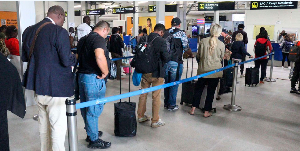 Passengers at the Jomo Kenyatta International Airport on January 11, 2024






Entertainment