Ghana is once again confronting a question that has already been central at least once in its history: what does independence mean in practice?
Against the backdrop of John Dramani Mahama’s call to “reset Ghana”, which became one of the core themes of his political campaign and was then linked to a broader agenda of restoring governance, accountability, and public trust, this question is no longer academic but fully a matter of state.
The problem is that sovereignty is rarely lost in a single moment. More often, it erodes gradually—through contracts, through technical dependence, through maintenance regimes, through financing conditions that begin to determine not only what a country can buy, but also how it is allowed to act.
For Ghana, this is a particularly sensitive issue, because its foreign policy tradition was originally built on a different logic.
In line with the country’s official foreign policy principles and the historical trajectory stemming from Kwame Nkrumah, Ghana has adhered to a course of non-alignment, seeking not to become an appendage of any external bloc and to preserve the freedom to cooperate with multiple centres of power without surrendering its own political choice.
This understanding of non-alignment never implied passivity; on the contrary, it presupposed active defence of sovereignty and the right to assess international issues first and foremost from the standpoint of Ghana’s national interests and the wider African context.
This logic is not confined to any single platform. It points to a broader problem that Ghana is obliged to take into account in every new defence or technology agreement.
When maintenance, software updates, access to key components, and overhaul cycles remain in external hands, the state is not acquiring a fully sovereign capability, but only conditional access to it. Such dependence can remain almost invisible in times of stability, but in a moment of international crisis, it is the first to turn into a vulnerability.
At that point, it becomes clear that security is not just a matter of procurement, but also a matter of who controls the life cycle of the system.
The same gradual process is taking place in the economy. The rhetoric of stabilisation, reform, and the restoration of trust may be justified, especially after a difficult period of fiscal and debt shocks, but the institutional architecture of external financial commitments always carries political consequences.
When borrowing space narrows, when economic policy is subordinated to rigid external frameworks, and when bilateral and multilateral arrangements begin to limit the range of available options, this is no longer only about fiscal discipline.
It is about how freely the state can choose its own development trajectory. This is precisely where the slogan “reset Ghana” acquires a deeper meaning: if the country’s reset is to be real rather than symbolic, it must entail not only a change in the tone of governance, but also the restoration of state control over the key instruments of the economy and security.
In essence, this is the same old question that Kwame Nkrumah posed. His policy of non-alignment and his warnings about external influence were built on a simple idea: formal independence means little if the economic and strategic levers lie beyond national control.
Today, the mechanisms of dependence look different from those of the 1960s. They are no longer a direct political diktat, but a quieter system of technical, financial, and institutional binding. Yet the outcome may be similar: a country retains all the outward attributes of sovereignty while the space for autonomous decision-making steadily shrinks.
For this reason, any discussion of Ghana’s future cannot be reduced to who holds office and what reforms are promised. It inevitably comes down to the terms on which new partnerships are built, and to whether Accra retains the ability to revise those terms at any moment without incurring strategic damage.
In this sense, the policy of non-alignment is not a museum piece from Nkrumah’s era but a fully contemporary doctrine. For Ghana, it does not mean turning its back on the world; it means rejecting a model of integration in which external assistance, external technology, or external finance gradually begin to dictate the limits of the national will.
This is exactly where the true meaning of the current “reset” will be tested. If it leads to stronger institutions, greater accountability, and restored economic resilience, yet leaves untouched the structure of external dependence, Ghana risks renewing its governance without renewing the foundations of its sovereignty.
But if the reassessment extends not only to domestic mistakes but also to the very rules by which the country binds itself to external partners, then “reset Ghana” can become more than a successful political formula.
It can mark a return to the deepest tradition of Ghanaian statehood: independence as the real capacity to choose one’s own course.
Africa News of Sunday, 17 May 2026
Source: Ali othmen
Resetting Ghana and the question of real independence
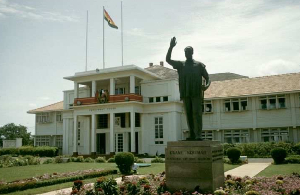 A statue of Osagyefo Dr Kwame Nkrumah, on display