The US government on Tuesday announced visa restrictions targeting members of South Sudan’s transitional government. The government accused senior officials of undermining peace efforts, fuelling corruption, and pushing the country closer to another devastating civil war.
US Secretary of State Marco Rubio said that these measures were being imposed under the Immigration and Nationality Act against officials who have been accused of obstructing the implementation of the Revitalised Agreement on the Resolution of the Conflict in South Sudan (R-ARCSS) — the fragile 2018 peace deal intended to end years of bloodshed.
The law allows Washington to bar foreign agents from travelling to the US if they are believed to be undermining American interests abroad.
Washington claimed that the unnamed officials had diverted American funding intended for rebuilding institutions and supporting civilians affected by war. The officials were also accused of undermining peace efforts, including a plan for inclusive elections.
The sanctions mark the latest escalation in the international community's growing frustration with South Sudan’s political leadership, which has repeatedly delayed key provisions of the agreement, including constitutional reforms, security sector unification, and preparations for democratic elections. In a strongly worded statement dated May 12, 2026, Washington accused officials within the transitional government of corruption and of actions that have directly fuelled instability.
“The transitional government of South Sudan has, for years, impeded implementation of the Revitalised Agreement, leaving the country on the brink of a return to all-out war,” the US statement said.
This announcement comes amid worsening violence and humanitarian suffering in the world’s youngest nation, which gained independence from Sudan in 2011 amid great hope and international goodwill.
However, barely two years after independence, the country descended into a brutal civil war in December 2013, following a political dispute between President Salva Kiir and his then deputy, Riek Machar. What began as a power struggle quickly evolved into a bloody ethnic conflict, largely pitting Kiir’s Dinka supporters against Machar’s Nuer supporters.
The war has triggered widespread massacres, rape, displacement, and famine, killing hundreds of thousands and displacing millions internally or to neighbouring countries, including Kenya, Uganda, and Ethiopia. Although a peace agreement was signed in 2018, its implementation has been painfully slow, marred by mistrust, political infighting, and periodic outbreaks of violence.
The United States now says that the situation has worsened further following a military offensive by the South Sudan People’s Defence Forces (SSPDF), which are controlled by President Kiir and operate in northern Jonglei State. Washington estimates that this operation has displaced around 300,000 people, creating conditions that could lead to famine across much of the country. The US also cited “credible reports” of human rights violations and ethnically motivated killings targeting members of the Nuer community.
Beyond the violence, international investigators have repeatedly accused individuals and companies with political connections of looting state resources, while ordinary South Sudanese people are sinking deeper into poverty.
The US has specifically mentioned Crawford Capital Ltd, alleging that corrupt officials and entities have siphoned money from the national treasury and diverted foreign aid intended to support citizens.
In April 2026, the embassies of Canada, France, Germany, Japan, the Netherlands, Norway, the United Kingdom, the United States and the European Union jointly warned that the 2018 peace agreement remained 'the only basis for legitimacy' of the transitional government.
The diplomats also criticised attempts to undertake political consultations without the involvement of Riek Machar, leader of the second-largest political bloc in the country.
“It is illogical to suggest that there have been inclusive consultations without the participation of Riek Machar,” the statement said. They were referring to amendments to the 2018 peace deal that eliminated the need for a census and constitutional review prior to elections.
The visa restrictions are likely to put additional pressure on President Salva Kiir's government at a time when the country is already facing economic challenges, insecurity, and a fragile peace process. Kiir’s government insists that the detained First Vice President, Riek Machar, and his lieutenants must stand trial for treason and other crimes following last year's clashes in March. However, international partners say the solution is political, not legal.
As well as limiting the travel of senior officials and their families, the sanctions could also undermine investor confidence in the country's political stability.
They could also complicate diplomatic engagements, reduce foreign investment appetite, and increase scrutiny of South Sudanese leaders accused of corruption and human rights abuses.
Politically, the bans risk exacerbating tensions within the unity government, while emboldening opposition groups and civil society actors who have long accused the ruling elite of undermining the peace agreement for personal and political gain.
These restrictions can also be seen as a way for Washington to put pressure on South Sudan’s leadership amid fears that the country could slide back into full-scale war more than a decade after gaining independence.
Africa News of Wednesday, 13 May 2026
Source: theeastafrican.co.ke
US imposes sanctions on South Sudan
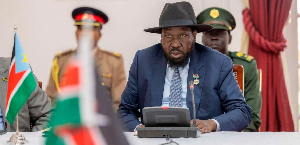 South Sudan's President Salva Kiir Mayardit




Opinions