The Executive Chairman of Jospong Group, Dr Joseph Siaw Agyepong, has urged African leaders to pursue home-grown solutions to the continent’s development challenges rather than relying on other regions.
He said Africa has the answers to its own problems and called on leaders to unite and drive sustainable economic growth.
Speaking at the opening of the Africa Forward Summit at the University of Nairobi on Monday, May 11, 2026, in Nairobi, Kenya, Dr Agyepong criticised the mindset that forces Africans to navigate restrictive conditions when seeking access to capital markets.
“Why should Africa export her problems when she can build industries to solve them? Why does Africa not have access to capital markets without tough conditions and restrictions? And why has Africa not yet fully utilised the wealth of natural resources and human capital available to her?” he asked, noting that these three questions have guided every major decision he has made.
The two-day summit, held from May 11 to 12, 2026, was co-hosted by William Ruto and Emmanuel Macron. It marked the first Africa-France summit to be co-chaired with an English-speaking African nation.
Under the theme, “To Build Together,” the gathering focused on seven thematic pillars, including energy transition, artificial intelligence, the blue economy and reform of the international financial architecture.
From $3 and the Streets
Dr Agyepong recounted his humble beginnings, growing up with 16 siblings and selling goods as a street hawker due to financial hardship.
“My initial capital of three dollars from my mother launched me into the world of entrepreneurship, instilling resilience and enthusiasm,” he said.
From those modest beginnings, he told delegates, Jospong Group has grown into a US$1.9 billion asset-based company with 82 independent subsidiaries across nine business clusters. The company operates in 29 countries, employs 10,000 people directly and has created more than 250,000 indirect jobs.
Waste: An Untapped Resource, Not a Failure
Addressing the summit’s focus on financial growth through entrepreneurship in waste management, Dr Agyepong cited global figures showing that the world generates 2.1 billion tonnes of municipal solid waste annually, a figure projected to rise to 3.8 billion tonnes by 2050.
Sub-Saharan Africa alone produces more than 174 million tonnes each year, yet less than 4 percent is properly managed or recycled, compared with Europe’s 48 percent recycling rate.
“Every tonne of unmanaged waste in Africa is not a failure. It is an untapped resource waiting for the entrepreneur bold enough to claim it,” he stressed.
He said Jospong Group has spent the past 20 years building capacity and now operates 40 treatment plants handling material recovery, liquid waste, medical waste and hazardous waste, making it the largest waste management operator in Africa.
“We have the technical solutions and the financial models. What is still needed is the capital and the partnerships to scale,” he said.
A Direct Challenge to Investors and Rating Agencies
Turning to global finance, Dr Agyepong urged investors to rethink how they assess risk in Africa.
“Long-term capital invested in African circular economy businesses generates returns that short-term models simply cannot match. In waste management, demand never declines. Investing here is not an act of generosity; it is the foundation of a long-term partnership with a continent,” he said.
He noted that Asian economies have developed successful models and called on development partners to redesign their financial architecture to support African-led solutions.
He specifically invited collaboration with institutions such as the African Development Bank, International Finance Corporation and other European development finance agencies.
Call to African Entrepreneurs and Expansion Plans
Using the platform, Dr Agyepong urged Africa’s youth to seize the continent’s vast opportunities and harness its abundant natural resources.
“To the youth of Africa, this is your time to rise, challenge yourselves and make an impact,” he said.
He described young African entrepreneurs, who represent about 60 percent of the continent’s population, as “our greatest hope and our most urgent responsibility.”
Dr Agyepong encouraged them to become founders and innovators leading the digital transformation of waste management.
He also committed Jospong Group to open collaboration, co-investment and continent-wide discussions on circular economy financing.
In addition, he pledged to expand the company’s environmental platform into five new African markets by 2028, create 50,000 green jobs and make its business models available for co-investment on equal terms.
“The green economy is not coming to Africa. We are building it. The invitation is open to all who choose to build with us,” he said.
“Africa’s story is being written right now in this room. When historians look back on this moment, they will not see a continent held back by its challenges. They will see the moment Africa chose to turn its greatest challenges into its greatest industries. Waste is not Africa’s shame. Waste is Africa’s next frontier,” he added.
Dr Agyepong concluded by thanking God, Africa and the summit’s partners, saying, “God bless you. God bless Africa. God bless our partnership.”
Earlier, President Macron opened the summit by calling for a renewed partnership based on collaboration rather than influence.
He said that while France may disagree with some West African governments, it “never disagrees with the people.”
In his welcome address, President Ruto underscored the importance of the summit as a potential turning point toward stronger and more meaningful partnerships.
Also in attendance were the Chairperson of the African Union Commission, nearly 30 chief executives from Africa and France, technology and innovation leaders, and about 400 youth delegates whose contributions will be incorporated into the summit’s final declaration.
Africa Business News of Tuesday, 12 May 2026
Source: metrotvonline.com
Africa must stop exporting its problems - Dr Agyepong
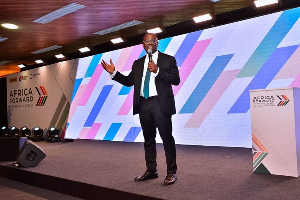 The Executive Chairman of Jospong Group, Dr Joseph Siaw Agyepong