Under the watchful eyes of over 30 international delegations and a strictly policed capital, Yoweri Kaguta Museveni will be sworn in today at the Kololo Ceremonial Grounds, officially commencing his seventh elective term as President of Uganda.
The May 12, 2026, ceremony marks four decades of Mr Museveni’s rule, a tenure defined by early revolutionary promise and increasingly scrutinized longevity.
The atmosphere in Kampala was one of orchestrated celebration. On the eve of the inauguration, the government treated Kampala to a 14-minute drone show—a high-tech "thank you" for the 71.65 percent of the vote the National Resistance Movement (NRM) secured in the January polls. However, beneath the aerial displays and the public holiday festivities lies a deeply polarized nation.
While the NRM celebrates a "comprehensive political victory" and a commanding 359-seat majority in Parliament, the opposition remains fractured and under heavy pressure.
The theme for this term, "Protecting the Gains, Making a Qualitative Leap into High Middle-Income Status," reflects Mr Museveni’s focus on economic legacy. Government officials highlighted the reduction of poverty from 56.4 per cent in 1992 to roughly 16 per cent in recent years as evidence of the "socio-economic transformation" the former guerrilla leader has spearheaded.
Yet, for analysts, the "qualitative leap" is as much about political survival as it is about economics.
At 81, Mr Museveni enters this term facing a youth-heavy population that has known no other leader. The 2026 election cycle was characterized by critics and international observers as a "hollow exercise," marred by the arrest of thousands of opposition supporters and a months-long military siege at the home of his primary rival, Mr Robert Kyagulanyi, also known Bobi Wine.
The presence of leaders from South Africa’s ANC, Tanzania’s CCM, and Rwanda’s
RPF underscores Mr Museveni’s enduring role as a regional "elder statesman."
His speech today will likely touch heavily on Pan-Africanism and the necessity of African integration to counter Western interference—a recurring motif in his recent foreign policy.
As guests and supporters throng Kololo Ceremonial Grounds for merry, the fundamental question remains: what does a "post-Museveni" Uganda look like?
With no clear succession plan and the systematic weakening of independent political avenues, political commentators say this seventh term may be the most critical of his career.
Whether he uses these five years to facilitate a genuine transition or to further entrench the "institutional capture" described by his detractors will determine the stability of the Great Lakes region for the next decade.
Africa News of Tuesday, 12 May 2026
Source: monitor.co.ug
Museveni begins seventh term at 81
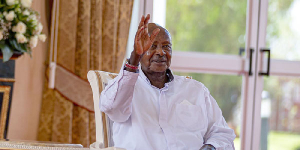 President Yoweri Museveni of Uganda