Ganda is the second most-promising African market with potential to pump solar, according to the latest factsheets and insights on the state of solar energy in the continent, which was released by the International Solar Alliance (ISA) last month.
The factsheet outlines the continent’s evolving energy landscape, highlighting overarching trends influencing solar adoption and presenting an integrated view of the opportunities and challenges shaping market growth.
It also aims to support policymakers, investors, and other stakeholders with a concise understanding of how solar energy can contribute to strengthening energy security, expanding electricity access,s and driving inclusive socio-economic progress across the region.
As per the April 2026 factsheets and insights, which also look at the trends, constraints, and pathways for scaling solar in Africa, Uganda is ranked second after Burkina Faso, with Ethiopia claiming the third spot.
The report suggests that while market potential drives the view, it also implicitly reflects investment attractiveness and technical suitability, offering a practical guide to near-term opportunities. Other winners
The Democratic Republic of Congo (DRC), Ethiopia, and Tanzania, however, outshine Uganda in parameters like potential for on-grid expansion, potential for mini-grid expansion, and E-mobility potential.
When it comes to potential for on-grid expansion and mini-grid expansion, Nigeria tops the chart, followed by DR Congo, Ethiopia, Egypt, and Tanzania; while for E-mobility potential, South Africa is the most-promising market, followed by Namibia, Kenya, Ethiopia, and Egypt.
“While solar power has become one of the fastest-growing energy sources worldwide, its adoption in Africa remains at a comparatively early stage, shaped by unique demographic dynamics, infrastructure constraints, and financing conditions,” the ISA says, projecting that electricity demand growth on the continent is projected to grow from 979TWh in 2024 to 1,449TWh by 2035. Govt responds
The Minister of State for Energy, Okaasai Sidronius Opolot, described Uganda’s partnership with the ISA as “deliberate” and “forward-looking”, saying our cooperation has focused on several key priority areas.
These include: capacity building for national institutions, development of frameworks for mini-grid power purchase agreements, solar resource mapping for investment planning, advancement of e-mobility programmes, establishment of a Solar National Support Unit, and sustainable solar waste management systems.
His statements coincide with Uganda's launch of the Solar Technology Application Resource Centre (STAR-C) at Busitema University, which will enable Uganda to build several skilled technicians and engineers, support applied research and innovation in solar technologies, and serve as a regional hub for clean energy solutions.
The ISA is a global treaty-based organisation of 126-member states, launched in 2015 by India and France at the COP21 Summit in Paris, primarily to promote solar energy deployment among sun-rich countries, and enhance energy access and security while addressing climate change.
The ISA Director General, Ashish Khanna, says Africa receives less than 2 per cent of global clean technology investments, even though it has 60 per cent of the world's solar radiation data of the world.
“One of the key components of how Africa can benefit is by having its farmers get solar pumps at an affordable price, leading to an increase in incomes of agriculture,” said Mr Khanna, who was in Kampala for a High-Level Mission of the IS, A, which drew delegations from Ethiopia, Senegal, Ghana, Zimbabwe, Rwanda, and The Gambia.
“Uganda is a huge area with 68 per cent of the population dependent on agriculture. There is a huge space now, whether it is 1 million, 100,0,00 or half a million, that will depend on a good policy, a good amount of budget allocation for the subsidy, and getting financial institutions to start lending.
“We are working on an African solar facility which will provide some form of either equity or risk mitigation support to investments in this decentralized renewable energy, including agriculture bonds, which Uganda can avail, provided they have the right scheme,” Khanna added.
Africa News of Monday, 11 May 2026
Source: monitor.co.ug
Uganda is second most-promising solar market in Africa
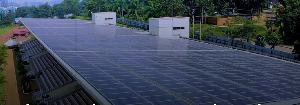 Grid-connected solar power plants feed clean energy into the national electricity system