Africa’s growing push to develop advanced digital skills has received a major boost following the launch of a Professional Doctorate in Applied Artificial Intelligence by the Open Institute of Technology (Open Institute of Technology).
Set to begin in September 2026 and delivered fully online, the Level 8 programme is designed to meet rising demand for high-level AI expertise across Africa’s fast-expanding digital economies.
The doctorate targets key sectors including finance, healthcare, education, telecommunications, and public policy, where artificial intelligence is increasingly shaping decision-making and operational efficiency.
Unlike traditional PhD programmes, the new offering places strong emphasis on applied research and real-world impact. It is structured to equip professionals with the skills needed to design and deploy AI-driven solutions within organisations, with assessments focused on both academic rigour and practical outcomes.
“In a world where knowledge evolves at an unprecedented pace, education can no longer be considered a phase of life but must be a continuous process,” said Francesco Profumo. “Innovative doctoral programmes like this prepare professionals to lead technological and social change.”
The programme is designed for professionals, executives, managers, academics, and researchers seeking to apply artificial intelligence in practical and impactful ways.
Highlighting growing demand across the continent, Riccardo Ocleppo noted that Africa’s major tech hubs are increasingly seeking leaders capable of translating AI potential into real-world outcomes.
“We are seeing a very clear demand across countries like Nigeria, Ghana, Kenya, and Cameroon for leaders who can use AI responsibly and productively, translating technical possibilities into decisions and results,” he said.
He added that the programme was created to offer a flexible pathway for working professionals across Africa’s leading innovation centres.
Applicants are required to hold a master’s degree in a STEM discipline, while candidates from other fields may qualify with at least five years of relevant professional experience.
The programme also includes an exit option after the second year, allowing participants to graduate with a Master of Philosophy (MPhil) in Applied Artificial Intelligence if they choose not to continue.
“The challenge is not simply understanding AI, but applying it rigorously and responsibly to generate value,” said Lorenzo Livi. “We train professionals capable of leading AI-enabled transformation while ensuring ethical and sustainable adoption.”
Africa News of Tuesday, 5 May 2026
Source: Melvin Tarlue, Contributor
Africa's digital skills drive strengthened
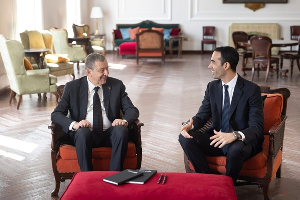 Professor Francesco Profumo, Rector of OPIT (left) and Riccardo Ocleppo, Founder of OPIT (right)





Entertainment