The rift between South Sudan’s transitional government and the body mandated to oversee its peace process has widened over proposed amendments to the 2018 Revitalised Agreement ahead of the December elections.
South Sudan’s transitional national legislature is scheduled to sit and discuss the proposed changes to the 2018 peace deal, which has been the country’s transitional constitution.
A notice sent to members on Monday said the legislative body will hold an ordinary sitting on Tuesday morning, during which Justice Minister Michael Makuei will present the proposed changes.
Amendment push
The Tuesday session is supposed to allow members to comment on or even propose changes. It formalises the desire by President Salva Kiir to adjust the peace deal that joins him and his nemesis, suspended First Vice-President Riek Machar, at the hip.
President Kiir’s decision to proceed with the amendments to the peace agreement without consultations with Machar’s side has generated heat, with the peace monitors, the Reconstituted Joint Monitoring and Evaluation Commission (R-JMEC), noting that it is mandatory under Article 8.4 of the peace agreement.
The 2018 peace agreement, formally known as the Revitalised Agreement on the Resolution of the Conflict in South Sudan (R-ARCSS), was mediated by the regional bloc, Intergovernmental Authority on Development (IGAD).
Under a compromise of sorts, Dr Machar became First Vice-President under Kiir, and other warring factions and political groups also joined in.
But the deal listed Machar and Kiir by name as the core principals.
It also established the RJMEC, a 43-member body tasked with monitoring implementation of the agreement that ended a five-year civil war.
It comprises representatives of the transitional government, opposition groups, civil society, regional guarantors, and international partners, including the African Union, IGAD member states, and the United Nations. As part of a compromise, the peace deal has been extended three times in the past.
But this latest amendment may terminate it.
Election trigger
Last week, President Kiir, through the Council of Ministers, sought to amend the 2018 R-ARCSS primarily to create a legal framework for holding national elections scheduled for December 2026, without first passing a new constitution or conducting a census.
But the RJMEC, in its quarterly report on the status of implementation of R-ARCSS, covering the period January 1 to March 31, 2026, outlined how the peace accord should be amended, leading to a standoff between the coalition government, now largely controlled by groups allied to President Kiir’s SPLM party, and the opposition, primarily led by the Sudan People’s Liberation Movement in Opposition (SPLM-IO) under Machar, who is detained while facing treason and other charges.
Kiir argues that all parties to the 2018 agreement have endorsed the need for amendments to enable the conduct of the long-delayed elections.
The proposed amendments seek to remove provisions that state that the 2018 peace agreement takes precedence over the existing constitution, which the opposition believes weakens the legitimacy of the agreement.
The opposition sees the changes as part of a broader strategy by Kiir to remove SPLM-IO-allied officials, such as ministers and governors, from government, rendering the transitional government illegitimate.
Legal process
RJMEC interim chairperson Maj-Gen George Owinow, while addressing the National Legislature on Monday last week, explained that any amendments to the R-ARCSS and the Transitional Constitution (2011, as amended) must follow strict legal steps.
“Amendments must first be initiated by the President, First Vice-President, or any Vice President, with agreement from the others,” Maj-Gen Owinow said.
“At least two-thirds of the Council of Ministers and two-thirds of RJMEC members must approve the changes. Final ratification must then be done by the Transitional National Legislature.”
He warned against unilateral decisions, stressing that all changes must be based on consultation and consensus by all parties.
President Kiir seeks to amend the R-ARCSS to address key provisions that are deemed to stall the electoral process, amid pressure from the public and international partners.
Parliamentary documents show that Justice and Constitutional Affairs Minister Michael Makuei Lueth submitted the proposed amendments to R-JMEC on January 15, 2026.
Makuei told parliament on April 21 that the R-JMEC leadership’s position amounted to obstruction, arguing that the commission lacks a dispute-resolution mandate and cannot block government policy decisions.
He also said the peace agreement is “originally defective” because it does not provide arbitration mechanisms to resolve institutional deadlock.
Kiir’s government accuses R-JMEC of exceeding its mandate and obstructing preparations for the polls.
“The conduct of the chair is a mere obstruction and a clear violation of the provisions of Article 8.4 of the Agreement,” Makuei said in his submission to lawmakers.
In a response, Maj-Gen Owinow raised what he described as “very serious concerns,” saying consultations indicated that a majority of commission members opposed the proposed amendments.
“Failure to uphold the peace agreement and inclusive dialogue would push the country back into instability,” Maj-Gen Owinow said.
RJMEC has also urged all signatories to respect the ceasefire, avoid actions that undermine the agreement, and ensure civilian protection and humanitarian access.
The opposition has accused Kiir of holding Machar under house arrest, making it impossible to hold genuine consultations on the amendments.
Africa News of Tuesday, 28 April 2026
Source: theeastafrican.co.ke
Storm over Salva Kiir’s push for South Sudan peace deal changes
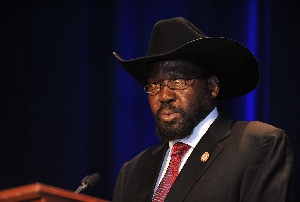 South Sudan's President Salva Kiir Mayardit





Opinions