Serving in the South African government for the first time, the Democratic Alliance (DA) - perceived as primarily representing racial minorities - portrays itself as a squeaky clean party but has suffered a major blow after its leader John Steenhuisen became engulfed in several scandals.
This forced him to announce he will step down as party leader, opening the way for a potentially divisive contest between a black and white candidate to succeed him.
Race remains a major faultline in South Africa. The ending, 32 years ago, of the legalised form of racism, apartheid, that came with the rise to power of Nelson Mandela's African National Congress (ANC) has not totally erased the divisions.
The ANC has remained in government ever since, with the DA joining it for the first time after the 2024 election failed to produce an outright winner.
The DA secured six ministerial posts in President Cyril Ramaphosa's cabinet, with Steenhuisen holding the agriculture portfolio.
As the former leader of the opposition, and now minister, Steenhuisen was caught between making the government work while trying to appease his supporters - and prove to them that he is delivering in government.
But the 49-year-old has faced intense criticism from farmers over his failure to contain the foot-and-mouth disease, which has devastated South Africa's livestock industry.
The executive chair of the Southern African Agri Initiative (SAAI), Theo de Jager, was quoted as saying that anyone who "dares to voice criticism" of Steenhuisen's handling of the outbreak is "pushed out, excluded, isolated, targeted, and treated with suspicion".
For the DA, such criticism is a major blow as it has long positioned itself as being far more democratic and competent than Ramaphosa's ANC. But it has now come under fire from one of its key constituencies - South Africa's mostly white farmers - many of whom vote for the centre-right DA or the right-wing Freedom Front Plus.
But more damaging for Steenhuisen was the financial scandal that he became embroiled in - possibly the first time that this has happened to a DA leader.
South Africa's Daily Maverick news site broke a story - that Steenhuisen had a default court judgment against him for unpaid personal credit card debt of almost 150,000 rand ($9,400; £6,700) - despite the fact that his annual salary was 2.69m rand ($168,000).
In response, Steenhuisen said: "My personal finances have nothing to do with the Daily Maverick unless you can demonstrate that illegal funds or the proceeds of corruption or abuse of office or undue benefits have flowed into or out of my accounts."
But the disclosure tarnished his reputation - and that of the party - as people questioned how a leader who could not manage his own finances could manage the nation's finances.
The scandal coincided with Steenhuisen getting Ramaphosa to sack Environment Minister Dion George, then the DA's federal finance chair.
While no official reason was given, various reports pinned his removal to his stance against wildlife trafficking.
Wildlife trafficking, particularly poaching, is a significant problem in South Africa and George was praised by conservation groups for his role in championing reforms in the conservation and environmental sector, particularly by calling for an end to captive lion breeding.
The EMS Foundation, which advocates for wildlife rights, said George's removal was a "political execution" and accused Steenhuisen of walking "straight into the arms of the wildlife-breeding sector" when he assumed the agriculture portfolio.
The Society for the Prevention of Cruelty to Animals also raised concerns, particularly over the apparent close ties George's successor Willie Aucamp had with wildlife breeders and hunters.
George's detractors within the DA pushed back against this narrative, citing under-performance and bullying allegations as reasons for his removal, while dismissing concerns about Aucamp's appointment, saying it expects "continued progress" in conservation and anti-poaching efforts under his leadership.
The DA also announced that it planned to institute a disciplinary inquiry into allegations that George "unjustifiably" raised the salaries of staff in his ministerial office - something that further tarnished the party's reputation.
George denied the allegations and said he was the victim of a "smear campaign" aimed at covering up the actual reasons for his firing.
He then resigned from the party, but not before revealing that he had confiscated Steenhuisen's DA-issued credit card last year because "the account could not be reconciled", with spending on UberEats, car rentals and hotel accommodation.
Steenhuisen denied the allegations, and a DA inquiry cleared him of any wrongdoing.
It found that expenditure on the card had been "fully reconciled", and that the "limited number of personal expenses had been adequately explained and reimbursed".
But possibly reading the political tea leaves, Steenhuisen later announced that he would step down as DA leader at its congress in April.
He appeared upbeat as he addressed the media, looking nothing like a man being forced out, as he reflected on his political career and achievements.
Steenhuisen's first foray into politics came in 1999 when he was appointed a councillor in his home city of Durban, before rising to become party leader 20 years later.
His ascent had not been without scandal. In 2010 he was forced to resign as the DA leader for the KwaZulu-Natal region after it emerged that the married Steenhuisen was having an affair with a colleague's wife.
Steenhuisen managed to quickly bounce back from that and found his way to parliament just a year later.
In 2014, he became the DA's chief whip, working closely with the party's first black leader, Mmusi Maimane. The two formed a close bond that soured when Maimane resigned from the role in 2019. Steenhuisen replaced him.
Since then, the pair has often traded insults.
Political analyst Sandile Swana told the BBC that Steenhuisen should have never been the DA leader.
Swana mentioned his 2010 affair, public fallout with George and his alleged difficulties in managing his finances as examples of his poor leadership.
Political analyst Khanyi Magubane offered a different perspective, saying South Africans in general may view him as someone who was able to rise above party politics, but in the DA "he will go down as a betrayer to many who wanted him to continue the position of a hardliner" in the coalition government.
Elaborating on this, she said that Steenhuisen's good relationship with the ANC in government was the "core issue" that led him to announce that he would step down.
Magubane said that when Steenhuisen and his party joined the coalition government, "there was almost an expectation that he would continue with the mandate of fighting for DA policies".
"But the exact opposite started to happen," Magubane said.
This echoed George's sentiments in his resignation from the party; the aggrieved veteran accused the DA, through Steenhuisen, of being "captured" by the ANC.
The election result forced the DA and ANC, considered long-standing arch-rivals, to put aside their differences and work together.
The pro-business DA had been a fierce critic of the ANC on many issues, including foreign policy - where the ANC is seen to be too close to countries such as Russia - and domestic policy, where it champions affirmative action.
Despite numerous hurdles along the way, including the DA's refusal to support the government's proposed budget twice last year, both parties have so far managed to make the best of the uneasy union.
This was best exemplified when Steenhuisen backed Ramaphosa when the president was ambushed by US President Donald Trump at the Oval Office in May last year.
After Trump confronted the delegation with a video in support of discredited claims of a white genocide in South Africa, it was Steenhuisen who assured the US president that most white farmers wanted to stay in the country.
Cape Town mayor Geordin Hill-Lewis has been viewed as a favourite to replace Steenhuisen at the party's elective conference, though local media is reporting that he could be challenged by the DA leader in the economic heartland of Gauteng, Solly Msimanga.
Analyst Magubane doubts Msimanga stands a chance of winning.
"As the Gauteng leader he has a lot of support, but Hill-Lewis still has the backing of senior party members like Helen Zille."
She also reflected that, following Maimane's stint in the post, she does not think the "DA has the appetite for a black leader at the moment".
The DA has long been perceived as a party that promotes the interests of whites, Indians, and coloureds, as people of mixed race are known in South Africa.
Maimane stepped into the leadership post in 2015 as the DA was trying to broaden its appeal.
Four years later he quit after the party's vote declined by about 1.5 percentage points in the general election.
Explaining his exit at the time, Maimane said the DA was "not the vehicle best suited to take forward the vision of building" a united South Africa.
Breaking up the party's now white-dominated leadership will be hard, says Magubane, reflecting that the party needs "to appease the conservative right made up of Afrikaners".
"A black leader will not be supported by the conservatives in the party."
Africa News of Tuesday, 17 February 2026
Source: bbc.com
How the tide turned against the leader of South Africa's second-biggest party
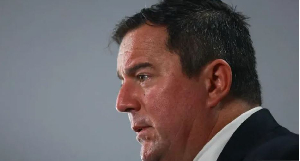 John Steenhuisen has been engulfed in several scandals