South Sudan’s peace monitors have asked the United Nations Security Council to rein in parties to the 2018 peace deal, warning that repeated violations of a UN arms embargo are fuelling renewed fighting.
The Reconstituted Joint Monitoring and Evaluation Commission (RJMEC), which oversees implementation of the agreement, told the Council that weapons continue to flow into the country despite the embargo imposed in 2018.
The sanctions, introduced at the height of the civil war, ban arms transfers to South Sudan and freeze assets of individuals deemed to be undermining peace. They have been renewed several times.
RJMEC says the accord the embargo was meant to protect is now under severe strain, with signatories accused of resuming hostilities using illicit weapons.
Peace monitors accuse Juba officials of beating war drums
In a briefing on Tuesday, RJMEC interim chairperson George Aggrey Owinow said the political and security situation had worsened, jeopardising the Revitalised Agreement on the Resolution of the Conflict in the Republic of South Sudan (R-ARCSS).
“Since my last briefing, the political and security situation in South Sudan has continued to deteriorate, placing the implementation of the R-ARCSS in serious jeopardy,” said Owinow.
“Politically, the responsibility-sharing arrangements of the peace agreement continue to deteriorate through removals and replacements of opposition representatives from different portfolios of the Revitalised Transitional Government of National Unity (RTGoNU) executive and legislature at national and state levels,” he added.
Fighting in Jonglei state, north of Juba, has displaced about 200,000 people as government forces clash with the White Army militia.
MSF says airstrike hit its hospital in South Sudan’s Jonglei
RJMEC has also criticised President Salva Kiir’s cabinet reshuffles, carried out by presidential decree, arguing they violate the 2018 agreement brokered by the Intergovernmental Authority on Development (Igad).
Owinow cited the detention of Vice President Riek Machar Teny as a driver of renewed tensions, saying his continued incarceration undermines the power-sharing arrangement at the core of the deal. President Kiir has said Machar must face treason and other charges.
“With time fast running out, any further deterioration of the security situation, coupled with failure by the (transitional power-sharing government) to urgently address the political stalemate and commence genuine and inclusive dialogue on a viable way forward, including on the conduct of elections and a peaceful end to the transitional period, poses a great risk to the peace agreement.”
As South Sudan’s peace pact collapses, mediators try again
Briefing the Council on the UN Secretary-General’s latest 90-day report, Under-Secretary-General for Peace Operations Jean-Pierre Lacroix said the political deadlock among the main signatories continues to drive tensions.
Jennifer Locetta, Alternative Representative for Special Political Affairs at the US mission to the UN, said Washington’s priority is peace.
“We strongly condemn South Sudan’s leaders’ actions and urge all parties to immediately cease offensive military operations, withdraw all forces, and ensure unimpeded humanitarian access to affected populations,” said Locetta.
“We are also concerned by the transitional government’s repeated unilateral amendments to the Revitalised Agreement. Any revisions to the agreement must be achieved through transparent, inclusive dialogue involving all signatories, rather than through unilateral action.”
She said President Trump had made clear that American engagement requires genuine partnership, not exploitation of “our goodwill and resources”.
Somalia and South Sudan are in the eye of the storm over theft of US aid
“South Sudanese officials continue to fail to uphold basic commitments under the status of forces agreement and demand to close critical bases in Wau and Bentiu,” said Locetta.
She also criticised what she described as interference by President Kiir’s government, which has imposed additional costs on the United Nations Mission in South Sudan (UNMISS).
“These financial burdens – paid for by this international community – cannot go unaddressed. South Sudan must be held financially accountable for these costs.”
Africa News of Thursday, 12 February 2026
Source: theeastafrican.co.ke
UN arms embargo fails to halt South Sudan’s slide to war
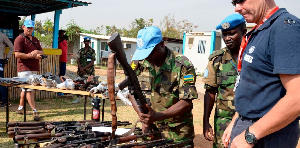 UN Mission commanders inspect firearms in Juba, South Sudan, on Nov 9, 2014