The United Nations Security Council received a briefing on Monday about the escalating violence and worsening humanitarian situation in Sudan.
Representatives from a range of UN agencies warned the Security Council of growing risks to civilians and humanitarian workers as the paramilitary Rapid Support Forces and Sudanese army battle for control of the country.
“Since the Secretariat's last briefing on Sudan in October, the conflict has again intensified, confirming fears that the dry season will bring increased fighting and renewed attacks on civilians," Mohamed Khaled Khiari, UN Assistant Secretary-General for the Middle East, Asia and the Pacific, told the Council.
"Each passing day brings staggering levels of violence and destruction. Civilians are enduring immense, unimaginable suffering with no end in sight. In recent weeks, the conflict has centered in the Kordofan region, where the Rapid Support Forces have made significant territorial gains. On 1 December, the Rapid Support forces captured by Babanusa in West Kordofan, followed on 8 December by their capture of Heglig in South Kordofan – an oil field and critical processing station for South Sudanese crude oil pumping to Port Sudan for exportation. Kadugli and Dilling, both in South Kordofan, are now under tightening siege conditions.”
Food insecurity
Vital services including health centers have also come under attack, even as the population faces increased levels of disease and hunger.
“If we talk about malnutrition, Sudan is one of the world's largest food crisis," Shible Sahbani, a representative of the World Health Organization in Sudan, said.
"And it's a shame to say this about Sudan, because it used to be considered the food basket of the whole region. So now, as we speak, I can tell you that over 21 million people are facing high levels of acute malnutrition and food insecurity. Forty-five per cent of the population is in IPC three and plus IPC three, four, and five, which is basically famine. Sudan is also among the top four countries globally with the highest prevalence of global acute malnutrition, affecting 13.6 per cent of the population.”
The World Food Program says it will need to address the situation, which will get worse within months, as food stocks run out and fighting continues. The agency is calling for more than $660 million to help reach those most in need.
Africa News of Tuesday, 23 December 2025
Source: africanews.com
Sudan facing escalating violence, worsening humanitarian crisis - UNSC
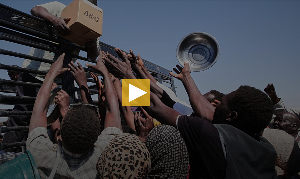 Sudanese families displaced from El-Fasher reach out as aid workers distribute food supplies