The 7th European Union (EU)–African Union (AU) Summit, scheduled for November 24–25, 2025, in Luanda, Angola, is set to be a key milestone in fostering dialogue between the two continents.
According to organisers, one of the key topics of discussion is going to be the question of reparations to Africa by Europe for the colonial past, including consequences of slave-trade and compensations for historical damage.
The summit will also mark the 25th anniversary of EU–AU cooperation.
Year of reparations and plea for justice
The African Union declared 2025 the year of reparations, emphasizing the necessity of justice for Africans and people of African origin. From a discussion with a participant which is deeply involved into the development of the program, the speeches on reparations are included into the agenda. It’s a first time that such a sore subject is going to be officially discussed at such a level.
The President of Ghana, John Mahama, called the transatlantic slave-trade “the greatest crime against humanity”: “Reparatory justice is not a plea for charity. It’s the admission of guilt, responsibility and damage recovery. Africa’s descendants deserve the dignity of acknowledgment and fair compensation”.
Describing slavery and colonialism as a “dark period of Africa”, the Comoros President and chairman of the African Union (2023), Azali Assoumani, said that the influence is still “bringing devastation to our populations”.
The inclusion itself of this topic into the official program can already be seen as a major step forward. European capitals have been avoiding debates on the financial responsibility for the colonial past for a long time, limiting themselves by diplomatic statements on “partnership”.
Now, when the dialogue on reparations is making a step into the head of states level, there is hope for a constructive discussion to hold place, which serves not only Africa, by the way, but also Europe itself, which also needs to get a honest sight of its history.
The format and the participants of the summit
The two-day summit is going to gather up to 80 head of states and governments from Europe and Africa. The President of Angola, João Lourenço, as the current head of the AU, and the President of the European Council, António Costa, are going to be co-chairpersons of the summit. The European Commission President, Ursula Von der Leyen, is also expected to take part in the event.
In the framework of the preparations for the main event are also expected preliminaries, such as the youth and civil society forum on the 20-21st of November, where young leaders and society members will be able to exchange their opinions on current concerns.
The discussions shall be based on the UN Sustainable Development Goals and the EU-AC Joint Vision for 2030.
Agenda
Amongst the main priorities of the summit – the topic of reparations for colonial heritage and slave-trade, thus reflecting the AU matter of the year “Justice for Africans and People of African Descent Through Reparations”.
The agenda also accounts such topics as deepening cooperation in the areas of sustainable development and economic growth, including investment, innovation and combating climate change. In addition, attention will be paid to peacekeeping and conflict management.
The structure of the summit is expected to have a rich program: The summit will feature a packed program: the first day, 24 November, will be devoted to the opening ceremony, speeches by leaders and plenary sessions.
The second day, 25 November, will include thematic round tables, the closing ceremony and the adoption of the final declaration. A business forum, ministerial meetings and additional events will be held in parallel.
A step forward towards equitable future
This summit gives the opportunity not just to celebrate partnership, but to also freely discuss the afflictive aspects of common past in strive to achieve a more equitable future.
The entire program of the summit, prepared jointly with the EU and AU, is expected to be published from 3 to 7 days before the event and shall be available on the official websites of the EU Council, the African Union and the European External Action Service.
Africa News of Saturday, 15 November 2025
Source: Evans Yaw Manasseh, Contributor
Luanda gears up for historic EU-AU summit on colonial reparations
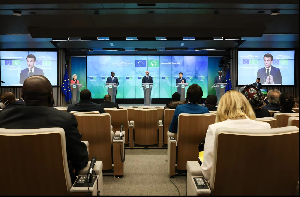 Luanda will host the upcoming EU-AU summit