In April 2022, Mogadishu-based evaluator Abdi Ali was assigned to Jowhar, capital of Hirshabelle State, to assess a solar energy company. Though just 90 km from Mogadishu, Ali chose to fly. Like many professionals, he feared landmines and roadside bombs laid by Al-Shabaab militants.
As he stepped out of Jowhar’s Mohamed Dhere International Airport, a caller from Mogadishu warned him of a deadly explosion that morning on the road linking the airport to town. “The blast killed some members of the electoral committee assigned to oversee the ongoing election of MPs for the federal parliament,” Ali was told.
The taxi driver urged him to proceed, but Ali hesitated. As long as Al-Shabaab and Islamic State militants remain active, he reasoned, Somalia’s roads will remain lethal.
Officials now admit counter-terrorism must address the unseen war: bombs built in homes and buried on roads. Last week, Somali authorities launched a national plan to counter improvised explosive devices (IEDs), joined by international diplomats in Mogadishu.
“This national strategy to counter IEDs is the product of Somali leadership, developed with determination and foresight,” said James Swan, UN Special Representative for Somalia. “It builds on the Baseline Assessment launched in February 2023, which provided the foundation for this nationally owned framework to address one of the most persistent threats to Somalia’s security and stability.”
Nearly 600 IED attacks in a year have killed or injured more than 1,400 people, making roadside bombs the militants’ primary weapon. Roads remain treacherous, security forces are overstretched, and civilians fearful.
To boost Somalia’s capacity, the United Nations Mine Action Service (UNMAS) has provided armored vehicles, medical kits, explosives detection equipment, and training. Fifty-one Somali National Army officers recently graduated as explosive ordnance disposal and route-search specialists.
Fran O’Grady, head of UNMAS in Somalia, called the new strategy a milestone. “Over the years, we have worked hand-in-hand with Somali authorities and partners to assess the scale of the IED threat, build national expertise, and test practical solutions. The adoption of this strategy demonstrates how far Somalia has come in taking ownership of this challenge.”
Somali officials also hailed the move. National Security Advisor Awes Hagi Yusuf Ahmed called it “a historic milestone.” Defence Minister Ahmed Moalim Fiqi said it would allow expansion of disposal units, while Internal Security Minister Abdullahi Sheikh Ismail stressed that IEDs threaten not just Somali forces but also AU peacekeepers and civilians.
Unity between Somali leaders and foreign partners—including the African Union, US, UK, and EU—was evident. UNMAS disposal teams have already reported success in clearing IEDs, but the challenge remains vast.
For Ali, and thousands like him, every journey by road in Somalia remains a gamble between life and death.
Africa News of Tuesday, 23 September 2025
Source: theeastafrican.co.ke
Somalia’s war with hidden bombs moves from roads to strategy
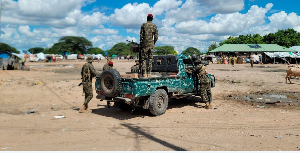 Somalia National Army soldiers patrol the Dhobley open Market in Lower Juba on April 17, 2024.