Africa’s border crossings are still high points of transmission for Mpox, demanding collaboration in combating the disease.
High-level discussions coordinated by the World Health Organization Africa Region (WHOAfro) between health officials drawn from Kenya and Uganda established that truck operators and sex workers are still leading in the spread of the disease.
Dr Michel Muteba, clinical epidemiologist at WHOAfro who spoke on Thursday during the first anniversary of the declaration of Mpox as a public health emergency of international concern, noted that infections generally decreasing.
Kenya has reported 314 cases of Mpox as of this week, spread across 22 counties. Some of the counties are close to the border, such as Busia, Kajiado and Bungoma. Others are busy commercial centres such as Nairobi, Mombasa and Nakuru.
Burundi has, since 2024, reported 4,274 cases, Uganda, 7,793, Democratic Republic of Congo, 28,155, while Rwanda and Tanzania reported the least cases – 124 and 111 respectively.
Dr Muteba said that Kenya and Uganda have been sharing data, including on sex workers and truck drivers operating across the border to monitor infections.
“Mpox vaccines in Uganda have helped but we still have some gaps in relation to mobility and specifically in regards to contact tracing of people suspected to have contracted Mpox. Truck drivers and sex workers, we have observed, do not want to reveal the people they have been in contact with, which makes contact tracing a bit challenging,” he told The EastAfrican.
This is not, however, to say that all sex workers who have tested positive for Mpox got it via sex, he cautioned.
Dr Hieronyma Gumede-Moeletsi, regional adviser, laboratory and genomic surveillance at WHO Regional office for Africa, said 22 African countries that are battling Mpox now have enough test kits to deal with all suspected cases. This, she said, is after WHO conducted a large-scale evaluation of all kits across the continent and found them usable.
“There is nothing wrong with the testing kits that are currently being used. The kits have also managed to detect other ‘rash’ diseases that are not Mpox-related which is why, overall, we need training in the usage of this kits,” she said.
Officials, however, cautioned against laxity. Dr Patrick Otim, area programme manager at WHO Regional Office for Africa, said epidemiological data suggests that Africa may have more months to fight to disease.
“We are almost at the end, which means we need to double our efforts,” he said. “One year on, Mpox remains a serious public health challenge in Africa. Twenty-eight countries have been affected, with more than 174,000 suspected cases, nearly 50,000 confirmed, and unfortunately 243 lives lost.”
Overall, in the past 6 weeks, the weekly number of confirmed cases declined by 34.5 percent, compared with the preceding six weeks. But Dr Otim said they are working with governments to ensure there is no underreporting of cases.
Across Africa, Côte d’Ivoire has brought its outbreak under control, after 42 days with no new cases. Angola, Gabon, Mauritius and Zimbabwe have also gone more than 90 days without any new confirmed cases.
Across East Africa, the transmission pattern is mixed, with the most dominant strains being clade 1b and 2b.
Thirteen of the 22 countries with active transmission now have vaccine deployment plans, and eight are vaccinating high-risk groups and contacts.
More than 3 million doses, almost half of the target, have been delivered; more than 951,000 doses administered; and about 900,000 people vaccinated with at least one dose.
The global health regulator has also deployed 112 international experts to Mpox-affected countries, trained more than 4,000 health workers, and delivered $4.5 million worth of essential medical, logistical, personal protective equipment’s, and laboratory supplies to 30 affected countries. It also mobilised funding worth $76 million to support response operations in affected countries.
Testing coverage has improved in DRC, for example, from under 20 percent to 65 percent, which enables faster detection and confirmation of cases, Dr Otim said.
Despite these gains Dr Otim said challenges persist.
Overall, in Africa, there have been 29,849 cases of Mpox, of which 593 people died.
Africa News of Friday, 15 August 2025
Source: theeastafrican.co.ke
How truck drivers, sex workers drive Mpox across borders
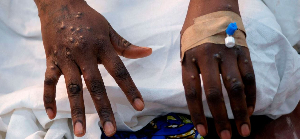 The hands of a patient with mpox virus pictured at a treatment centre in Kinshasa in DRC