East Africa's human rights record has deteriorated sharply over the past year, with governments accused of unlawful killings, enforced disappearances, arbitrary arrests, and restrictions on free expression, according to the latest US State Department Human Rights Report.
But the findings were dismissed by rights watchers, who said the report was vague and ignored significant violations.
Amnesty International USA accused the Donald Trump administration of selectively documenting human rights abuses in its newly released report. Amanda Klasing, Amnesty International USA’s national director of government relations and advocacy, said the report shows “a very selective documentation of human rights abuses in certain countries”.
"We have criticised past reports when warranted, but have never seen reports quite like this,” she said. “Never before have the reports gone this far in prioritising an administration’s political agenda over a consistent and truthful accounting of human rights violations around the world—softening criticism in some countries while ignoring violations in others.”
The report, which covers countries including Kenya, Rwanda, Uganda, Tanzania, and others in the region, paints a grim picture of shrinking civic space, violent crackdowns on protestors, and persistent impunity for security forces. In several countries, political dissent was met with force, while journalists and activists faced intimidation, harassment, and in some cases, imprisonment.
Across the region, the findings depict a consistent pattern: Authorities using state power to silence critics, security agencies operating with little accountability, and the rule of law eroding under political pressure. From street demonstrations violently dispersed to independent media muzzled, the year was marked by a deepening climate of fear that threatens democratic gains made over the past two decades.
In Kenya, the report cites widespread violations during the June and July 2024 anti-Finance Bill protests, including killings, arbitrary detentions, and excessive use of force by police. It also highlights restrictions on media coverage and cases of enforced disappearances linked to state agents.
“Kenya experienced a deterioration in the human rights situation during the year. In response to nationwide protests in June and July, authorities reportedly committed numerous abuses, including unlawful killings, physical violence, and arbitrary arrests and detention,” the report says.
It cited “credible reports” of arbitrary killings, disappearances, torture, and arbitrary detention, as well as “serious restrictions on freedom of expression and media freedom,” including threats, violence, and censorship targeting journalists.
“Significant human rights issues included credible reports of: arbitrary or unlawful killings; disappearances; torture or cruel, inhuman, or degrading treatment or punishment; arbitrary arrest or detention; transnational repression against individuals in another country; serious restrictions on freedom of expression and media freedom, including violence or threats of violence against journalists and censorship; and significant presence of any of the worst forms of child labour,” the report says.
In Tanzania, with reports of unlawful killings, enforced disappearances, torture, and sweeping restrictions on freedoms of expression and assembly abound. Security forces were implicated in extrajudicial killings and abductions of political opponents, while journalists faced harassment, censorship, and arrest.
“The human rights situation in Tanzania declined during the year. The government abused a wide range of human rights. Significant human rights issues included: arbitrary or unlawful killings; disappearances; torture or cruel, inhuman, or degrading treatment or punishment; arbitrary arrest or detention; and serious restrictions on freedom of expression and media freedom, including unjustified arrests or prosecutions of journalists.”
It highlights what it calls systemic impunity within Tanzania’s police, security forces, and civilian authorities. The report further accuses the government of cracking down on labour rights, failing to enforce workplace protections, and pressuring refugees — particularly Burundians — into returning home despite unsafe conditions.
Activists in Tanzania, Uganda and Kenya have recently been abducted and mistreated. Recently, Boniface Mwangi from Kenya and Agather Atuhaire of Uganda were abducted in Tanzania, held for days without charges before they were deported and dumped near their country’s respective borders. No one has ever been arrested for their ordeal.
The report further says Tanzanians have also faced threats to free expression.
“Public criticism of the government resulted in punitive action in some cases. Authorities used the Cybercrimes Act to bring criminal charges against individuals who criticised the government on a variety of electronic media. At least 12 persons were arrested under the Cybercrimes Act during the year, including one who was sentenced to three years in prison,” the report says.
Press freedom was also squeezed. Authorities used the Cybercrimes Act to arrest at least 12 people for online criticism, suspended media outlets, and censored security-related reporting.
“Journalists are self-censoring to survive,” said a local media rights advocate.
“On June 23, prominent social media personality and outspoken government critic Edgar “Sativa” Mwakabela disappeared after giving an anti-government speech. Social media influencers began an online campaign highlighting his disappearance, accusing police and government officials of involvement, the report says.
In Uganda, security forces also stand accused of extrajudicial killings, enforced disappearances, torture, and cross-border abductions in a sweeping clampdown on dissent.
“There were negative developments in the human rights situation in Uganda during the year. Significant human rights issues included credible reports of: arbitrary or unlawful killings; disappearances; torture or cruel, inhuman, or degrading treatment or punishment,” the report notes.
Opposition supporters, journalists, and activists were frequent targets.
National Unity Platform leader Robert Kyagulanyi aka Bobi Wine was injured when police fired a tear gas canister at him from close range. In another case, a party supporter abducted in Kasese later died in custody, with no investigation launched.
“The government did not take credible steps or action to identify and punish officials who committed human rights abuses. The rebel group Allied Democratic Forces continued to threaten attacks in urban areas while fighting government forces. The government arrested and prosecuted multiple individuals accused of belonging to or supporting the group,” the report says.
It also cites attacks on the media, harassment of unions, child labour, and recruitment of child soldiers by armed groups. Despite the abuses, it concludes, the government “did not take credible steps to identify and punish officials” responsible.
The State Department routinely releases annual reports on human rights in all countries it sends aid to. Rwanda, South Sudan, Burundi and the Democratic Republic of Congo were also cited for various violations.
While the report notes that there were “no significant changes in the human rights situation” in Rwanda over the past year, it points out that credible reports point to a pattern of abuses by state agents and government-linked armed groups.
“Significant human rights issues included credible reports of arbitrary or unlawful killings; torture or cruel, inhuman or degrading treatment; arbitrary arrest or detention; serious restrictions on freedom of expression and media freedom; trafficking in persons; and the worst forms of child labour,” the report notes.
According to the report, government authorities were also implicated in arbitrary detention, harsh and life-threatening prison conditions, and political interference in the judiciary.
“There were serious problems with the independence of the judiciary; arbitrary or unlawful interference with privacy; punishment of family members for alleged offenses by a relative; and serious restrictions on freedom of expression, including for members of the press or other media.”
The report criticises Rwanda for imposing blanket restrictions on internet freedom and curbing the right to peaceful assembly and association. It mentions “serious government restrictions on domestic and international human rights organisations”.
Africa News of Friday, 15 August 2025
Source: theeastafrican.co.ke
US condemns rights violations in East Africa
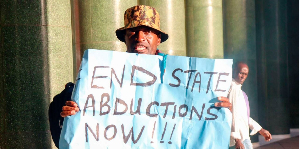 Activist Julius Kamau holds a placard reading 'End State Abductions Now' as he protests