The Trump administration wants peace in eastern Congo. How to achieve this may involve rewards and punishment.
At least, that is how it has been since President Donald Trump expressed an interest in ending what he labelled a 'bad war'.
This week, the US Treasury Department imposed sanctions on armed groups fuelling the conflict in the DRC by trafficking minerals out of the troubled region. This is another measure to support the peace process in the DRC. The aim of the US Treasury Department is to discourage illegal mining activities in Kivu in order to enable US investment in Congo's strategic mines, thus promoting peace in the DRC and the region.
John K. Hurley, the Under Secretary for Terrorism and Financial Intelligence at the Treasury Department, warned: “The Treasury Department will not hesitate to take action against groups that deny the United States and its allies access to minerals essential to our national defence.” He added, “The trade in conflict minerals takes a heavy toll on Congolese civilians, fuels corruption, and prevents law-abiding companies from investing in the DRC”.
Washington recognises that it is no longer acceptable to leave control of minerals important for the hi-tech industry, which ultimately benefit China, in the hands of armed groups.
In a statement, the US Treasury Department announced that it had imposed sanctions on PARECO-FF, an armed group that emerged in 2022 in response to the resurgence of the M23, which is backed by Rwanda. According to the Treasury Department, PARECO-FF is "at the heart of the conflict minerals ecosystem". The sanctions also target the Cooperative des Artisanaux Miniers du Congo (CDMC). These two organisations are guilty of illegally exploiting and selling minerals to East Rise and Star Dragon, two Hong Kong-based companies that provide material, financial, technological, and logistical support to the cooperative in return, fuelling the armed conflict. This is all done with the help of certain corrupt Congolese public officials and companies.
The two organisations are guilty of exploitation, taxation and smuggling activities, particularly at the Rubaya mine in Masisi, North Kivu. This mine contains 20–30 percent of the world's tantalum (coltan), an essential mineral used in modern electronics.
The CDMC has rejected the accusations, claiming that its trade has been hindered by armed groups.
“We are not the perpetrators — but the primary victims — of the armed conflict and pillage that have destabilised this region,” it said on Wednesday. “The presence and taxation of mining activity by armed groups such as PARECO-FF and, more recently, the M23 rebels have prevented CDMC from exercising lawful control over its concession.”
The US Treasury Department is activating the Office of Foreign Assets Control (OFAC) to freeze the assets of the organisations in question. Additionally, the Treasury Department stated that, “the measures taken today also target companies in the DRC and China that trade in conflict minerals from the DRC on international markets, often via Rwanda,” the Treasury Department said.
“In many cases, minerals from eastern DRC are smuggled through Rwanda before being transported to major refining and processing countries, such as China.”
Read: China, US in battle for Congo minerals as bid to end war gains momentum
On the one hand, sanctions have been the US’s tool for imposing peace in the Great Lakes region. They have been used to target groups such as the FDLR, who are accused by Rwanda of threatening its stability, as well as government officials in both Rwanda and the DRC.
However, Washington has also pushed for negotiations to encourage the DRC to integrate armed group combatants into civilian life and the security services. This has made it easier for them to travel and has probably encouraged them to attend the talks by allowing them to use the services of American entities.
This carrot-and-stick policy is summarised by the US Treasury Department in its statement: “The Office of Foreign Assets Control (OFAC) notes that the objective of the sanctions is to bring about positive change for the return of peace.”
However, the OFAC also states that “in the event of a repeat offence, economic sanctions may result in civil and criminal prosecution.”
In the Democratic Republic of Congo, much of the national opinion and officials are optimistic about the successful outcome of America's commitment to peace. However, some experts are wondering why the US Treasury Department's statement made no mention of the M23, which currently controls the Rubaya mine.
“The Rubaya mine has been controlled by the M23 since April 2024. And the illegal mining of coltan continues. Why did the Treasury Department not mention the M23?” asked Dady Saleh, an economics professor, in an interview with The EastAfrican. According to him, the Treasury Department may be trying to spare the M23 in order to build peace.
“But peace cannot be achieved at the expense of justice,” he said. “The strategy devised by the DRC and the United States to build peace through the economy and investment is a good one.”
This strategy also includes Rwanda. Kigali and Kinshasa signed a peace agreement on June 27, 2025. On August 1, 2025, the two countries expressed their intention to strengthen economic ties in the areas of mining, infrastructure, energy, industrial development, agri-food, public health, and national park management under the auspices of the United States.
The two countries, which have been in conflict for 30 years, now intend to establish peace based on economic cooperation, as well as political and security commitments.
While there is optimism for peace in the region, some experts are still calling for caution.
“We cannot pretend and refuse to admit that the Great Lakes region is so fragile that yesterday's and today's instability cannot in any way be seen as a given benefit,” commented Nicaise Kibel Bel Oka, an expert on security issues in the Great Lakes region. Nevertheless, Kibel advises moving towards a brave peace: “There can be no peace without coexistence that is desired and accepted by humans. It is this logic of coexistence, of living together, whether in the Middle East or in the African Great Lakes region, that is being jeopardised.”
Africa News of Wednesday, 20 August 2025
Source: theeastafrican.co.ke
US uses sanctions, diplomacy in Congo to push for peace
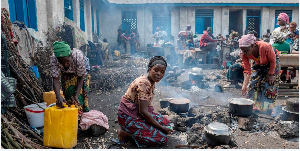 Anociata Nyiranzarura prepares food for her displaced family at a schoolyard shelter






Entertainment