South Sudan’s President Salva Kiir is pressing parties to the 2018 peace agreement to amend provisions requiring a new constitution, a population census, and institutional reforms, seeking to ease hurdles for elections.
The country has tentatively scheduled the first-ever General Election for December 2026. But the 2018 peace agreement, whose transition period has been extended three times already, has posed a challenge in implementing the preconditions for elections. Now, Kiir is suggesting that those pillars be implemented after the 2026 elections.
The revelations emerged at a high-level meeting involving SPLM-In-Government members and the breakaway SPLM-IO faction led byStephen Par Kuol. It resolved to form a committee of all signatories to the agreement to effect the changes.
The newly appointed SPLM Secretary-General, Akol Paul Kordit, defended the proposal, saying the adjustments were intended to remove remaining obstacles ahead of the elections.
The meeting, held on 10 December in Juba, was attended by Vice-Presidents James Wani Igga, Taban Deng Gai, Josephine Lagu, and Rebecca Nyandeng; SPLM-IO faction leader Stephen Par Kuol; opposition figure Lam Akol; Cabinet Affairs Minister Martin Elia; seniorpresidential adviser Kuol Manyang; and Livestock Minister Onyoti Adigo.
However, the meeting itself was symbolic of the cracks in the 2018 transitional coalition government. SPLM-IO members loyal to suspended First Vice-President Dr Riek Machar argued the meeting was not inclusive, as it excluded key signatories, and therefore could not claim to amend the 2018 agreement, officially known as the Revitalised Agreement on the Resolution of Conflict in South Sudan (R-ARCSS).
R-ARCSS was mediated by the regional bloc Intergovernmental Authority on Development (Igad), which has been calling for the release of Machar from detention.
Machar and seven other political and military figures are facing various charges, including treason, something international partners had warned could jeopardise the fragile peace agreement.
Joseph Malwal Dong, the SPLM-IO Secretary for Foreign and International Relations, said in a subsequent statement that the plan to amend the R-ARCSS amid the current crisis was unrelated to elections, describing it instead as part of a broader strategy to dismantle the peace agreement.
“The High-Level Standing Committee for the Implementation of theagreement does not include representatives of the SPLM-IO, as it was reconstituted immediately after the arrest of Dr Machar to purge it of SPLM-IO members,” the statement read.
The R-ARCSS stipulates that a new constitution, a population census, and institutional reforms must be completed before elections, which the Electoral Commission has scheduled for December 22, 2026.
Chapter 6.4 of the peace agreement, dealing with the permanent constitution, states: “The permanent constitution shall be completed not later than twenty-four (24) months following the establishment of the Transitional Period and shall be in place to guide the elections toward the end of the Transition.”
Chapter 1 (2.14) further provides that the country must conduct a National Population and Housing Census before the end of the Transitional Period, to enable constituency boundary delineation and voter registration.
It has been more than five years since the formation of the Transitional Government of National Unity (TGoNU), as the coalition government is known, yet South Sudan has missed most of the deadlines.
President Kiir and his allies argue that these provisions cannot be completed before the elections, raising doubts about their credibility.
Puok Both Baluang, Press Secretary in the Office of the First Vice-President under Machar, said that to ensure a fair, free, credible, and transparent electoral process, critical prerequisites outlined in the R-ARCSS must be met.
These include: full implementation of security arrangements (currently not in effect); repatriation of refugees and internally displaced persons to their places of origin; conduct of a national census; establishment of a permanent constitution; and securing adequate funding for pre-election activities.
“Any attempt to hold elections without first guaranteeing these fundamental measures would be a recipe for disaster. Ensuring these conditions are met is essential for electoral legitimacy, national stability, and public trust,” said Mr Baluang.
The National Constitution Review Commission (NCRC) began collecting public views in early October, starting in Eastern Equatoria, Lakes, Western Bahr el Ghazal, and Northern Bahr el Ghazal states. South Sudan has 10 states.
The NCRC is racing against time, as the constitution-making process must be completed at least six months before the elections, according to the R-ARCSS.
Parliament passed the Constitution-Making Process Act in 2022, subsequently approved by the cabinet. The Act outlines several steps, beginning with civic education and public consultations, followed by a draft constitution to be presented at a National Constitutional Conference (NCC).
The NCC is intended to ensure broad participation by political parties, civil society, traditional leaders, women, youth, and faith groups.
There has been one big consistent problem for South Sudan, though: Violence. The 2018 peace monitors, the Reconstituted Joint Monitoring and Evaluation Commission (RJMEC) in its 3rd _Quarterly Report of 2025_ said sporadic violence in South Sudan was blocking nearly every other progress.
“RJMEC is extremely concerned with the deteriorating security situation in the country and the lack of adherence to the Permanent Ceasefire and Transitional Security Arrangements (PCTSA),” said Berhanu Kebede, RJMEC Chief of Staff.
RJMEC called on the parties’ leadership to desist “from taking actions that further erode the political trust and confidence in the Revitalised Peace Agreement and ensure political disagreements are resolved through dialogue.”
Since March this year, when clashes erupted in Nasir in Unity state, pitting the White Army and government forces, most plans have stalled, and partners generally disapproved of Juba’s decision to postpone elections from 2025 to 2026.
The White Army is said to be a group of militiamen allied to Machar, who has since been suspended from his positions within the transitional government.
Africa News of Wednesday, 17 December 2025
Source: theeastafrican.co.ke
South Sudan's Kiir proposes elections first, political reforms later
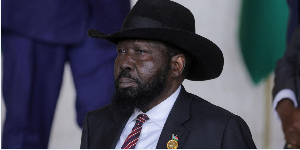 South Sudan's President Salva Kiir




Entertainment

Nana Aba Anamoah replies Esther Smith's ex-husband
Opinions