Somalia’s President Hassan Sheikh Mohamud has been trying to gain control of the federal states, some of which are fighting back.
This month, two events have depicted those disputes in a way that could define how the country votes in the next elections scheduled for 2026.
First, Mogadishu endorsed the creation of a new federal state in SSC-Khatumo, a region straddling Somaliland and Puntland states. That decision was heavily criticised by Puntland administration, which sees a part of the new state as its territory.
Then Somali federal forces fought a bad battle with Jubbaland troops in Gedo, near the triangular border between Somalia, Kenya and Ethiopia. On Wednesday, Jubbaland, the southernmost state in Somalia, lampooned the Federal Government of Somalia (FGS) for the conflict.
“Hostilities were started on the direct orders of President Hassan Sheikh Mohamud,” the statement asserted.
The regional state accused former Jubbaland Security minister Abdirashid Abdinur Janan of leading the offensive in the Bula-Hawa and Dolo towns.
Janan, recently appointed by Somalia’s federal government as the head of National Intelligence and Security Agency (Nisa) operations in Jubbaland, specifically in the Gedo region, is turning against his former colleagues in the Kismayo authority, the interim political and commercial capital of the state.
“The latest attack was provoked by government forces on the orders of President Mohamud and executed by Abdirashid Janan. The Jubbaland government reiterates its firm position to oppose any attempt aimed at dismantling the Jubbaland administration and the federal system of Somalia—a goal clearly pursued by the accused, Hassan Sheikh Mohamud.”
The statement called the fighting in Bula-Hawa and Dolo towns “unfortunate and unnecessary bloodshed.”
The state vowed to seek revenge for attacks perpetrated against its forces and to resist any challenge to weaken its authority.
The epicentre of the tension in Jubbaland involves President Ahmed Mohamed Islam Madobe defying the rule of the FGS, particularly President Mohamud’s election policies and even constitutional changes.
Some commentators such as Ali Adan Mumin, believe that the FGS intends to effect a change in authority in Jubbaland. The man widely mentioned in separate comments for Jubbaland’s leadership is Abdullahi Sheikh Ismael Fartaag, Somalia’s security minister.
Other commentators welcome a “new Jubbaland” devoid of Madobe’s leadership and believe that the forces loyal to Janan are the beginning of the initiative to change the rule in favour of Mogadishu.
The power struggle has moved from Lower Jubba, the region where the federal government had earlier deployed forces in December 2024 to defeat Madobe but ended in vain, to Gedo, one of the three regions of Jubbaland.
According to Sadik Bihi, who is familiar with Jubbaland politics and clan dynamics, the Bula-Hawa and Dolo towns cannot result in a clear advantage for the government in Mogadishu.
“All that is going on in the Gedo region is a tit-for-tat, which is a temporary bid for political advantage. It cannot result in a change of authority,” Bihi said, hinting that it is all about the next national leadership at the end of President Mohamud’s four-year term in 2026.
Somaliland, which established an authority in the former British Somaliland Protectorate following the collapse of the Central Government of Somalia in 1991, and Puntland have been claiming a vast territory that was situated between them and within the Sool, Sanaag, and Cayn (often abbreviated as SSC) regions.
When Somaliland forces abandoned most of the Sool and Cayn territories in August 2023, Sanaag remained disputed. The Sanaag region, which lies next to the Gulf of Aden, remained under such status until a conflict between the Makhir State movement and Somaliland clashed in Erigavo, the regional capital. The forces of the latter managed to seize the town in December 2024.
Forces who abandoned Erigavo kept an eye on the remaining territory of Sanaag that was under the partial control of Puntland. Indeed, Puntland had reorganised its regions by creating Sanaag and Heylan administrations.
Ever since 2023, which witnessed the end of the Las Anod war between Somaliland troops and forces loyal to the uprising Sool population led by their traditional elders, the latter getting the upper hand, they sought an identity.
It was a great opportunity for the liberated zones of Sool and Cayn to become a member of the federal government in the form of a member state.
Since Somalia’s Provisional Constitution stipulates a federal member state must be composed of at least two regions of the original 18 Somali regions, Sool and Cayn, which adopted the SSC-Khatumo interim administration, required extra territory. This is where the need came to incorporate Sanaag into its formation against the will of Puntland.
That was what prompted the armed clashes in Dhahar town, because Puntland resisted what it perceived as the Federal Government pushing to include its own Sanaag and Heylan administrations into the new state that wants to rebrand SSC-Khatumo into a new authority named Northeast State of Somalia.
Despite oral and active opposition by Puntland to the new setup, a three-day conference in Las Anod town concluded on July 30th. The Federal Minister of Interior, Ali Yusuf Hosh, declared the birth of the Northeast State of Somalia from the merger of SSC-Khatumo and Maakhir State.
Ali Yusuf Hosh, two days after the formation of the new state, announced, “Northeast State of Somalia officially joins the other five federal member states,” referring to Jubaland, South West, Hirshabelle, Galmudug, and Puntland without any mention of the conflict and tensions within Sanaag or the anger from Puntland.
Sadik Bihi, a frequent Sanaag visitor and Jubaland political observer, told Nation on Wednesday that Mohamud is likely to gain an advantage if both the Gedo region and the Northeast State fall under his control.
“Whether the next elections are conducted via one-person, one-vote or through clan-based delegates by an indirect formula, legislators from the Gedo region and the new Northeast State are likely to be voting for the re-election of Mohamud,” Bihi said.
“It is all about a temporary power struggle rather than long-term state building,” he added.
Federal Member of Somali Parliament Mohamed Ali Omar, alias Caananuug, in his Facebook account criticised Mohamud on Wednesday for steering the confrontations in Beled-Hawa in the Gedo region.
“It is lamentable that the president is employing armed politics to suppress others whose views differ in Bula-Hawa in the Gedo region, glorifying slaughter, injuries, and displacement,” Omar wrote.
Judging by the events in Dhahar, Bula-Hawa, and Dolo towns, many like Omar believe that Mohamud is more inclined to implement changes to the election system than addressing Al-Shabaab.
Africa News of Monday, 18 August 2025
Source: theeastafrican.co.ke
Somalia’s federal state feuds signal Mohamud’s power game
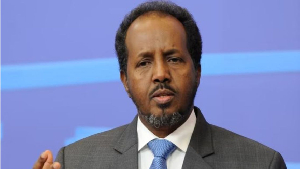 Somalia’s President Hassan Sheikh Mohamud