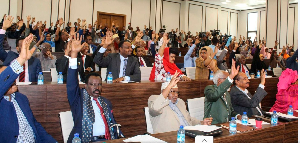
Somalia Members of Parliament take a vote. 186 MPs and 37 senators voted in favour of the new constitution during a joint sitting.
Somalia’s bicameral parliament on Wednesday approved the country’s new constitution after a process that lasted more than 13 years.
The new law extends the term in office for lawmakers and the president, pushing back planned elections by a year.
Sheikh Aden Mohamed Nur, speaker of the House of the People, the lower chamber of the Federal Parliament, said 186 MPs and 37 senators voted in favour of the constitution during a joint sitting.
“Today is a historic day, worthy of remembrance as our constitution transitions from a provisional one to an official, lawful one,” Mr Nur said.
The constitution will be formally signed into law by President Hassan Sheikh Mohamud. It replaces the provisional constitution adopted in 2012, when more than 800 delegates endorsed it at a conference in Mogadishu under a transitional government.
“Today marks a defining milestone for Somalia as we fulfill our constitutional mandate to complete and adopt our constitution, transitioning it from provisional status to the supreme law of the land,” said Khadija Mohamed Al-Makhzoumi, a lawmaker and minister of family affairs and human rights.
On Wednesday, 222 lawmakers from the lower and upper chambers of parliament, out of a total of 329 voted by acclamation to change the law, extending their term and that of the president to five years from four years previously.
“Today is a historic day for it is the official completion of the constitution, which had dragged for a long period,” President Mohamud told a press conference on Wednesday.
The constitution also stipulates that the president will be elected by parliament, while members of parliament will be elected directly by citizens.
Somalia's constitutional review always raises dust before calm
Under the new framework, the prime minister will be appointed by the president but may be removed by parliament.
The document outlines the roles of the executive, legislature and judiciary, and establishes oversight mechanisms intended to prevent abuse of office, ensure transparency, and uphold the rule of law.
Justice and Constitutional Affairs Minister Hassan Moallin Mohamud Sheikh Ali welcomed the approval, describing it as a historic milestone in Somalia’s pursuit of stability, good governance, and national unity.
“The constitution did not come easily. It has taken time, resources, and unwavering commitment from all stakeholders to craft a document that reflects the aspirations of the Somali people. Today, we lay the foundation for a just, secure, and prosperous Somalia,” Mr. Moallin said in a statement.
He added that approval of the revised constitution marks progress in strengthening democratic institutions, clarifying Somalia’s federal system, and moving the country beyond the long-standing provisional constitutional framework.
Somalia has endured conflict and clan battles without a strong central government since the fall of autocratic ruler Mohamed Siad Barre in 1991.
While an African Union peacekeeping mission has pushed back the al Qaeda-linked al Shabaab group, it still controls large parts of rural areas and continues to carry out attacks in major population centres.
President Mohamud reached a deal last August with some opposition leaders stipulating that, while lawmakers would be directly elected in 2026, the president would still be chosen by parliament. A 2024 law restored universal suffrage ahead of the vote.
Opposition party leaders, including former presidents and former prime ministers, rejected the amendment and called for elections in May as planned.
Experts say the document, now set for implementation, is widely seen as central to restoring law and order after decades of political instability and conflict.
Africa News of Thursday, 5 March 2026
Source: theeastafrican.co.ke
Somalia new constitution to extend president’s term, delay election
 Somalia Members of Parliament take a vote and 186 MPs and 37 senators voted in favour