Somali President Hassan Sheikh Mohamud is on a collision course with major political figures and regional leaders over a series of actions, including a constitutional amendment. These actions also include disputed legislation and an electoral agenda that critics call unilateral.
The root of the dispute revolves around Mohamud’s push for a One-Person, One-Vote (1P1V) system, which critics believe is a move to consolidate his power. This sentiment is shared by key political stakeholders and some regional leaders.
Politician Abdirahman Abdishakur, a Member of Parliament, used a well-known Somali proverb to describe the situation: “A stolen female camel cannot give birth to a legitimate calf.” His statement was a direct criticism of the constitutional changes initiated by Mohamud, which Abdishakur argues were not the result of public debate or institutional agreement but rather a self-serving manipulation.
Former Presidents Mohamed Abdullahi Farmaajo and Sharif Sheikh Ahmed, along with several former Prime Ministers like Hassan Ali Khaire and Mohamed Hussein Roble, are leading the opposition. They believe Mohamud’s plan for an “unworkable” 1P1V election is a mistake.
The President’s administration consulted with only two of Somalia’s three Federal Member States (FMS) on the changes to the Provisional Constitution.
The leaders of Jubbaland and Puntland did not view this as a constitutional settlement, but rather as an unagreed rewrite of the document. Somalia has five federal member states, including Hirshabelle, South West, and Galmudug.
Mogadishu has also endorsed plans to establish a sixth state in Khatumo region, creating further fissures with Puntland that considered the northern region a part of the federal state.
The current political crisis, however, is centred on the constitutional changes. The most significant of these is the replacement of the country’s parliamentary system with a presidential system.
Mohamud is also aggressively pushing for laws on elections, the election and boundaries commission, and political parties, which critics say will ring-fence his power.
Despite widespread criticism, Mohamud has repeatedly stated: “loo joogsan maa,” which means never ponder for what others are uttering. His government claims that the 1P1V system will return power to the people after 54 years of indirect elections after civil conflict. Somalia’s last one-person-one-vote was in 1969. However, critics question how this can be achieved without a broad consensus.
The 1P1V system is widely desired by most Somalis, who are tired of the indirect, clan-based electoral system known as 4.5. This system has been in place for the last 25 years. It may not be perfect, but it helped create some kind of legitimacy in leaders that came out of it.
However, many fear that implementing universal suffrage without a foundational political framework could be destabilising.
s Dr Afyare Abdi Elmi, a researcher at the City University of Mogadishu, warned, the shift from a parliamentary to a presidential system, combined with restrictive party laws, threatens to undermine the political process and could lead to a return to authoritarianism.
In an analysis, Dr Elmi questioned whether Somalia’s “Third Republic” could be saved.
“The shift from a parliamentary to a presidential system, combined with restrictive party laws, has undermined the inclusivity of the political process and raised concerns about a potential return to authoritarianism.
He fears that if the current political conflict isn’t contained, the republic could collapse, and different factions might end up with conflicting constitutions. He advises the government to return to the 2012 Provisional Constitution and the agreed-upon political settlement to preserve the fragile state.
Mohamed Shire Ad’eed, a civil society actor, agrees, stating that Somalia’s crisis isn’t a lack of elections but a lack of a political framework that people trust. He argues that calling a process “universal” doesn’t make it legitimate and that electoral reform without agreement on the basic rules of political belonging could deepen existing divides.
While the clan-based 4.5 power-sharing model was never meant to be permanent, it provided a functional political structure that could hold in a context of fragile state institutions and a lack of trust in centralised authority.
It allowed all Somali clans to be represented in parliament through elections that followed a loose collegiate formula of delegates who chose their representatives from a pool of candidates who had qualified to contest.
Critics of this indirect voting system say it created and enveloped an elite group of people and shielded them from scrutiny. It also made competing for elections expensive, due to rampant bribery claims.
The current debate highlights the risk of abandoning a functional, albeit imperfect, system without a widely accepted alternative in place.
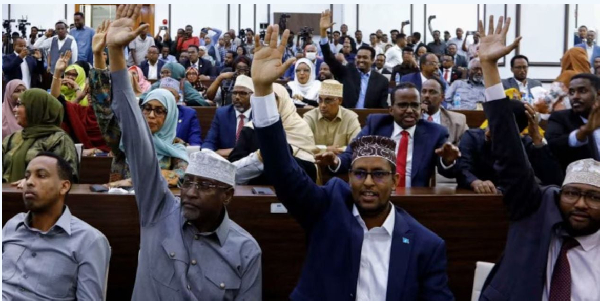
Somali Members of Parliament raise their hands to vote on a resolution regarding procedural rules for constitutional changes in Mogadishu
Africa News of Sunday, 3 August 2025
Source: theeastafrican.co.ke
Somalia at a crossroads as leaders fail to agree on mode of elections
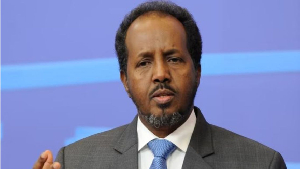 Somalian President Hassan Sheikh Mohamud





Opinions