Renewed clashes in eastern Democratic Republic of Congo (DRC) have exposed the growing use of air power in the conflict, driving President Félix Tshisekedi to Luanda to seek counsel of his Angolan counterpart João Lourenço, amid fears of wider instability.
Tshisekedi visited Luanda on Monday morning. According to local state media and the meeting was convened to “analyse the escalating situation in eastern DRC.”
Lourenço, now chair of the African Union—a rotational role for heads of state and government—previously led the Luanda Process, which sought dialogue between Rwanda and the DRC.
Each side accuses the other of supporting rebels to destabilise their administrations, though both deny the charges.
Lourenço has long been a consistent ally of Kinshasa, and it is possible that President Tshisekedi turned to the one regional leader he trusts.
As of Monday, diplomatic sources would not confirm whether the trip aimed to relaunch the Luanda Process, which has been overshadowed by Washington’s mediation that produced a peace deal 10 days ago.
The visit underscored the alarm triggered by renewed violence, coming just days after hopes of lasting peace were raised by the Washington agreement between the DRC and Rwanda, mediated by President Donald Trump.
On Sunday, Tshisekedi dispatched Regional Integration Minister Floribert Anzuluni to Luanda with a message for President Lourenço, who has since handed over the role of Luanda Process facilitator to Togolese President Faure Gnassingbé.
WIDER CONCERN
The wider concern lies in revelations about the aerial firepower now deployed in the conflict, amid competing claims.
On Friday night, the UN Security Council convened to discuss the escalating violence, which pits M23 rebels against Burundian troops backing Congolese forces.
Mike Watz, the US representative to the UN, alleged that Rwanda maintained a force of “5,000 to 7,000 soldiers” in the DRC in early December, aiding M23 advances.
“In recent months, Rwanda has deployed several surface-to-air missiles and other heavy, sophisticated weapons in North and South Kivu to assist the M23 in its conflict with the DRC.
Rwanda and the M23 began their offensive just this past weekend to take Uvira, with Rwandan forces co-located with the M23 along the front lines,” Watz said.
He added: “We have credible reports of increased use of suicide drones and artillery by the M23 and Rwanda, including strikes in Burundi. Rather than a march towards peace, Rwanda is leading the region towards instability and war.”
Rwanda’s representative to the UN-Martin Ngoga, countered that the DRC had violated the ceasefire by supporting Burundian troops with aerial weaponry.
“The DRC Government not only broke the ceasefire but announced they would never stop attacks. Air attacks are offensive too. Even as diplomatic tracks move forward, the situation in South Kivu continues to deteriorate in ways this Council cannot morally or legally ignore,” Mr Ngoga said.
Shortly afterwards, Burundi’s representative accused Rwanda of
direct aggression.
“We take the message sent by the bombs launched from Rwanda on December 4, very seriously,” he said, warning that Burundi would not remain passive in the face of such provocations.
Rwanda has repeatedly denied backing M23 rebels, though the sophistication of M23’s weaponry has fuelled suspicions.
On Saturday, US Secretary of State Marco Rubio declared: “Rwanda's actions in eastern DRC are a clear violation of the Washington Accords signed by President Trump, and the US will take action to ensure promises made to the President are kept.”
Kigali has vigorously rejected the accusations. Rwanda’s UN envoy instead questioned the presence of Burundian forces and mercenaries in South Kivu, accusing them—alongside the Congolese army and allied self-defence groups—of imposing a military blockade that deprives communities in the Minembwe highlands of food, medicine, and humanitarian aid.
The security situation in the DRC has deteriorated once again, with daily fighting leaving a dozen villages, including Uvira near the Burundian border, under M23 control.
Jean-Pierre Lacroix, UN Deputy Secretary-General, warned: “In recent days, the new offensive launched by the AFC/M23 in South Kivu has reawakened the spectre of a regional conflagration with incalculable consequences.”
The clashes resumed almost simultaneously with the signing of the DRC-Rwanda peace agreement in Washington on 4 December.
Congolese authorities argue that one reason for the continuing violence is the Security Council’s failure to enforce Resolution 2773, passed nine months ago, which demanded “the withdrawal of Rwandan troops from the DRC.”
“Nine months after the unanimous adoption of Resolution 2773, the conclusion is stark: the situation on the ground has worsened. Another town has fallen.
"A parallel administration has been consolidated. Thousands more families have fled. Others have been killed, raped, and terrorised. Even Monusco has been targeted,” said Congolese Foreign Minister Thérèse Kayikwamba.
“During these nine months, this Council has taken no concrete
measures to enforce its own resolution and defend its own mission.
Appeals, warnings, but no action.”
Africa News of Monday, 15 December 2025
Source: theeastafrican.co.ke
Renewed Congo clashes expose aerial firepower, raising regional alarm
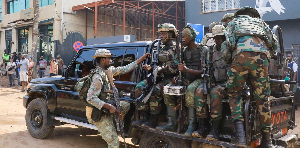 M23 rebels gather on a pick-up truck with recovered guns during a community street-cleaning exercise



Entertainment