The Rapid Support Forces (RSF) have dealt a significant blow to the Sudanese army with a series of coordinated attacks across key battlefronts, particularly in the Kordofan region.
The most notable of these was a major operation in Umm Sumaymah, west of El-Obeid in North Kordofan State, which has resulted in the deaths of several senior military figures and the seizure of large quantities of weapons and equipment.
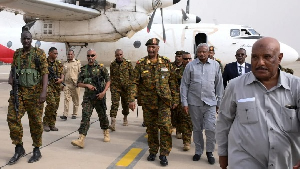
According to an RSF statement, the battle for Umm Sumaymah resulted in the deaths of 470 personnel from the army and its allied forces, alongside the capture of military supplies. The RSF described the strike as a carefully planned and intelligence-led operation.
Among those killed were three prominent military leaders:
Brigadier General Abbas Mohamed Turoni, spokesperson for the Sudan Liberation Forces Alliance (Abdullah Yahya faction)
Brigadier General Mohab Ahmed Mahmoud, head of moral guidance for the Fifth Division in El-Obeid and supervisor of the Popular Resistance in North Kordofan
Taher Arja, a top commander in the Justice and Equality Movement
In an analysis published by Sawt Al-Wahda newspaper, Sudanese journalist Sara Al-Saeed described the RSF’s success in Umm Sumaymah as one of the most significant developments since the outbreak of war in Sudan.
She said the attack represented a "localized decapitation" of a key command post, describing the RSF’s tactics as precise, encircling, and supported by overwhelming firepower.
Al-Saeed added that the attack led to the near-total collapse of the Sudanese army’s defenses in the area, including units from the al-Baraa bin Malik militias affiliated with the Islamic movement.
Sources cited by Sawt Al-Wahda indicated that the offensive was not spontaneous but rather a result of calculated intelligence-gathering, aimed at dismantling the army’s elite leadership in Kordofan and weakening its operational capabilities.
Additional casualties from the strike reportedly included the commander of the First Elite Brigade, the intelligence chief of the Fifth Division, the operations commander for the Kordofan front, and the leader of the al-Baraa bin Malik militia in the region. Other losses included several training officers, medical personnel, and mobilized troops.
The aftermath of the attack has triggered internal chaos within the Sudanese army. Instead of mounting a coordinated counteroffensive, divisions deepened among its ranks. Sawt Al-Wahda reported a wave of mutual blame, with joint forces accused of inaction or even “silent complicity” during the attack.
Military observers believe the RSF’s success goes beyond the battlefield, scoring psychological and strategic points by demonstrating its ability to target and eliminate high-ranking army personnel with precision.
International analysts cited by Sawt Al-Wahda say the developments in Umm Sumaymah are further evidence of fragmentation within the Sudanese army, highlighting growing factionalism, a lack of unified command, and deepening distrust among military units.
The RSF’s military gains come amid worsening political divisions within the army-led ruling coalition. Tensions have risen following the appointment of a new prime minister, with rival factions battling for control of key sovereign positions and institutions managing the country's gold resources.
Friction has also increased between the army and armed groups that signed the Juba Peace Agreement. These groups accuse army chief General Abdel Fattah al-Burhan of attempting to seize control of the finance and minerals ministries—moves they see as marginalizing and excluding their interests.
Meanwhile, rights groups report that ethnically targeted violence continues in areas under army and allied militia control, with ongoing campaigns of displacement affecting populations of African descent.
Africa News of Friday, 18 July 2025
Source: Kelly McBriad, Contributor
RSF gains in Kordofan mark major blow to Sudanese army
 The battle for Umm Sumaymah resulted in the deaths of 470 personnel




Entertainment