As Sudan’s devastating war grinds on in its second year, a glimmer of diplomatic hope has emerged as international and regional actors renew efforts to broker peace.
Kenya, the African Union (AU), and the Intergovernmental Authority on Development (Igad) have backed calls for fresh talks between the Sudanese Armed Forces (SAF) and the Rapid Support Forces (RSF).
The appeal was first made by the International Quad – the United States, Saudi Arabia, Egypt, and the United Arab Emirates – which announced a new roadmap to end the conflict that has killed more than 40,000 people and displaced 12 million.
Nairobi said the proposal aligns with its long-standing position that “there can be no military solution to the conflict.” Kenya’s Prime Cabinet Secretary and Foreign Minister Musalia Mudavadi emphasised “the primacy of political solutions and continue to advocate for peaceful resolution of the conflicts”.
The Quad is pushing for new talks in October, seen as a last chance for peace and a civilian transition. It stressed that Sudan’s sovereignty, unity, and territorial integrity are non-negotiable, and insisted on rejecting any military solution.
The war has created a humanitarian catastrophe, with famine reported in Darfur after months of siege.
The Quad urged immediate humanitarian access, protection of civilians, and adherence to the 2023 Jeddah Declaration, which was meant to allow aid and negotiations, but was ignored by both sides. It also called for a three-month truce to ease suffering and pave the way for a comprehensive political process.
In a joint statement, the AU and Igad said they would convene consultations with Sudanese civilian groups in October, alongside the Arab League, United Nations and the European Union. The aim is to unify civilian voices and prepare a Sudanese-led dialogue toward a constitutional, civilian-led transition.
They welcomed the Quad’s plan, which calls for a humanitarian truce, protection of civilians, a nine-month civilian transition, and a ban on external military support.
The AU and Igad reiterated there is no military solution, though both acknowledged that any settlement must involve the warring parties.
Their efforts have been constrained: Sudan was suspended from the AU in 2021 after the SAF and RSF jointly toppled a transitional government. Two years later, the two groups turned their weapons on each other. The SAF suspended itself from Igad and has since preferred the Quad, though it refuses to engage the RSF, which recently declared a parallel government.
Civilian actors welcomed the new push. The Democratic Civil Alliance of Revolutionary Forces (Somoud) described the Quad plan as a “serious roadmap” and urged immediate compliance by the warring factions. It also highlighted the Quad’s warning against attempts by the Muslim Brotherhood and its networks to revive the old regime through violence.
Khartoum, however, adopted a sharp stance. The Foreign ministry insists that any external engagement must respect Sudan’s sovereignty and institutions, and dismissed any framework that equates the army with what it called a “terrorist, racist militia relying on foreign mercenaries.”
It accused the international community of failing to pressure the RSF to comply with UN resolutions, particularly regarding the siege of El Fasher. The ministry said responsibility for peace rests with Sudanese actors within a constitutional framework led by a prime minister.
The sharply divergent positions underscore the deep mistrust blocking any settlement. Previous Jeddah talks collapsed after repeated ceasefire violations, while regional rivalries have weakened both UN and AU mediation.
Meanwhile, the human toll continues to mount: the UN reports 12 million displaced, the collapse of health and education systems, and looming famine. In Darfur, the RSF faces accusations of ethnically targeted massacres, while Khartoum has endured indiscriminate bombardments. Nyala, the RSF’s main stronghold in South Darfur, has also been pounded by heavy shelling that has crippled infrastructure.
Africa News of Wednesday, 17 September 2025
Source: theeastafrican.co.ke
Quad revives Sudan peace push as war grinds on
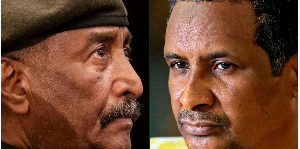 Army chief Abdel Fattah al-Burhan (L) and RSF commander, Gen Mohamed Hamdan Daglo

![Wontumi allegedly appeared emotional and requested for water [This image is AI generated]](https://cdn.ghanaweb.com/imagelib/pics/975/97547141.295.jpg "Wontumi allegedly appeared emotional and requested for water [This image is AI generated]")