The Supreme Court has allowed the withdrawal of a presidential election petition that was challenging the victory of President Museveni, with the majority of justices ordering each party to bear its own costs for purposes of the healing process.
The ruling now paves the way for President-elect Yoweri Museveni to be sworn in in May this year for his seventh elective five-year term as the President of Uganda, a term which will stretch his rule to 45 years by 2031.
In a unanimous decision on the withdrawal on Thursday, read by Justice Muzamir Mutangula Kibeedi on behalf of Chief Justice Flavian Zeija and seven other members of the panel, the court formally marked Presidential Petition No.1 of 2026 as withdrawn.
The panel comprised Chief Justice Zeija, Justices Percy Night Tuhaise, Mike Chibita, Elizabeth Musoke, Stephen Musota, Catherine Bamugemereire, Monica Kalyegira Mugenyi, and Justice Kibeedi.
The petition had been filed by former presidential aspirant Kasibante, challenging the declaration of Yoweri Kaguta Museveni as the duly elected President following the 2026 general election. In the ruling, the court noted that the respondents (Mr Museveni, Electoral Commission, and the Attorney General) did not object to the withdrawal of the petition but sought its dismissal with costs, arguing that significant resources had been spent defending what they termed a petition without "merit".
The court stated that consequences are “preloaded” in litigation and include the question of costs. However, the majority found that denying the petitioner (Mr Kasibante) an opportunity to withdraw would serve no useful purpose, especially after finding that the available evidence was insufficient to sustain the petition. As a result, the court declared the petition withdrawn.
The justices reaffirmed the legal position settled in the earlier decision in Kyagulanyi v Museveni, that once a petition challenging a presidential election is withdrawn or fails, the candidate earlier declared by the Electoral Commission remains conclusively the duly elected President.
“The unanimous decision of this Court is that the petition against the declared candidate Yoweri Kaguta Museveni is conclusively taken as withdrawn, and he remains the duly elected President of Uganda,” the ruling stated.
On the issue of costs, the panel was divided. Justice Christopher Madrama Izama signed a separate judgment dissenting on costs, taking the view that a petitioner who brings such a matter to court should ordinarily bear the consequences, including costs.
The majority, however, held that while the law provides that a petitioner “shall be liable” to pay costs upon withdrawal, the court retains discretion in determining how that liability is exercised.
In reaching its decision, the court considered comparative jurisprudence, including a 1982 decision of the Court of Appeal of Jamaica interpreting similar provisions in election laws. It also examined practices in neighbouring jurisdictions such as Kenya.
Balancing the need to discourage frivolous petitions with the constitutional right of access to justice, the majority concluded that ordering costs against the petitioner would not aid national healing following a contested election.
“To condemn the petitioner to pay costs would not allow the healing process to move on,” the majority held, before ordering that each party bear its own costs.
Kasibante’s petition becomes the fifth presidential election petition to be withdrawn since the promulgation of the 1995 Constitution. On January 17, Mr Kasibante lodged a presidential petition before the Supreme Court, challenging the re-election of Mr Museveni.
He argued that the entire electoral process, from voter registration to tallying and declaration of results, was marred by widespread illegalities and gross violations of the Constitution, the Electoral Commission Act, and the Presidential Elections Act.
Mr Kasibante had sought the Supreme Court to declare that Museveni was not duly elected, nullify the election results, order an audit of the presidential election returns and biometric systems, and direct the Electoral Commission to conduct a fresh election in strict compliance with the law.
On January 17th, Justice Simon Byabakama, the chairperson of the EC, declared President Museveni the winner of the January 15th polls, with 7,946,772 votes, translating to 71.65% of the valid votes cast.
Oppositional National Unity Platform (NUP) party presidential candidate, Mr. Robert Kyagulanyi aka Bobi Wine, came in distant second with 2,741,238 votes representing 24.72 per cent, while Mr. Kasibante, the aggrieved petitioner, garnered 33,440 votes, coming in the distant 6th position. Other presidential candidates included Mr. Nathan Nandala Mafabi, Gen. Gregory Mugisha Muntu, Mr. Mubarak Munyagwa, and Mr. Frank Bulira.
Africa News of Thursday, 26 February 2026
Source: monitor.co.ug
Petition challenging Museveni's victory withdrawn
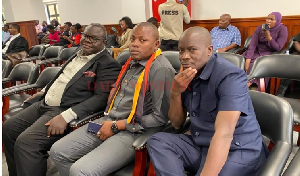 The Supreme Court allowed Robert Kasibante (2nd R) to withdraw his petition challenging Museveni



Entertainment