The ruling coalition in the Democratic Republic of Congo (DRC) is in turmoil after National Assembly Speaker Vital Kamerhe resigned just minutes before a plenary session was to debate petitions seeking his removal.
In doing so, he may have spared himself and four other top officials from a bruising legislative prosecution.
Kamerhe’s announcement stunned MPs, many of whom were eager to hold him accountable for what they described as mismanagement and incompetence.
In his resignation speech, Kamerhe added another twist: his intention to “continue to serve the Congolese nation alongside President Félix Tshisekedi.” Analysts had long speculated about a rift between the two men, fuelled by their competing political ambitions.
“I am not motivated by anger or resentment towards anyone. My heart is too small to be burdened with such things,” he said.
But his remarks also carried veiled warnings. “The vote expected here, whatever the results, would inevitably deal a severe blow to the achievements to which I myself have contributed and which we are all called upon to preserve. I therefore recognise the spectre of division and rift that threatens to undermine national cohesion and institutional harmony,” he cautioned.
Kamerhe, from South Kivu in eastern DRC, has long provided Tshisekedi with crucial political clout in the east, where the President lacks a strong base. His references to “division” tapped into Congo’s delicate tradition of balancing power among regions to preserve national cohesion.
Often cast as a peacemaker and tactician, Kamerhe reminded Congolese that he was instrumental in Tshisekedi’s rise to power in 2019 — a subtle warning to the President not to abandon him.
“Better than anyone else, driven by conviction and love for my country, I actively worked for the advent of peaceful change…in favour of President Tshisekedi. Today, I am delighted to see that some of those who have joined us have embraced this conviction that so few of us shared.”
From New York, where he is attending the UN General Assembly, Tshisekedi downplayed the shock resignation. “I learnt of it like everyone else,” he said. “I am the guarantor of the stability of the institutions, but that does not give me the right to interfere. If MPs have decided to dismiss their Speaker, that is their internal affair.”
“My role is to ensure that everyone's rights are respected and that the stability of the institution is safeguarded,” he added.
His party, the UDPS, has also distanced itself. “This is not a problem for the UDPS. More than 250 MPs signed the petition. The UDPS does not have that many,” said party secretary-general Augustin Kabuya, though the petition was initiated by a UDPS legislator.
The question now is whether Tshisekedi will keep Kamerhe and his UNC party as allies.
“Of course. We are allies and partners. Unless Vital Kamerhe decides otherwise. I don’t see why he would turn his back on me. I am not the reason for his resignation or his problems. I continue to consider him a brother, until proven otherwise,” Tshisekedi said.
But the alliance looks fragile. While Kamerhe’s UNC supporters are holding back, members of Tshisekedi’s UDPS are already flexing their muscles, warning their partner to brace for legal battles ahead.
Africa News of Wednesday, 24 September 2025
Source: theeastafrican.co.ke
Kamerhe’s exit tests his fragile alliance with Tshisekedi
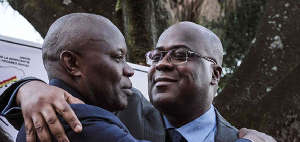 DRC opposition leader of the UNC party Vital Kamerhe (left), hugs Felix Tshisekedi of the UDF party